
Table of Contents
ToggleSalt Spray Tester
Salt Spray Tester Manufacturer in India
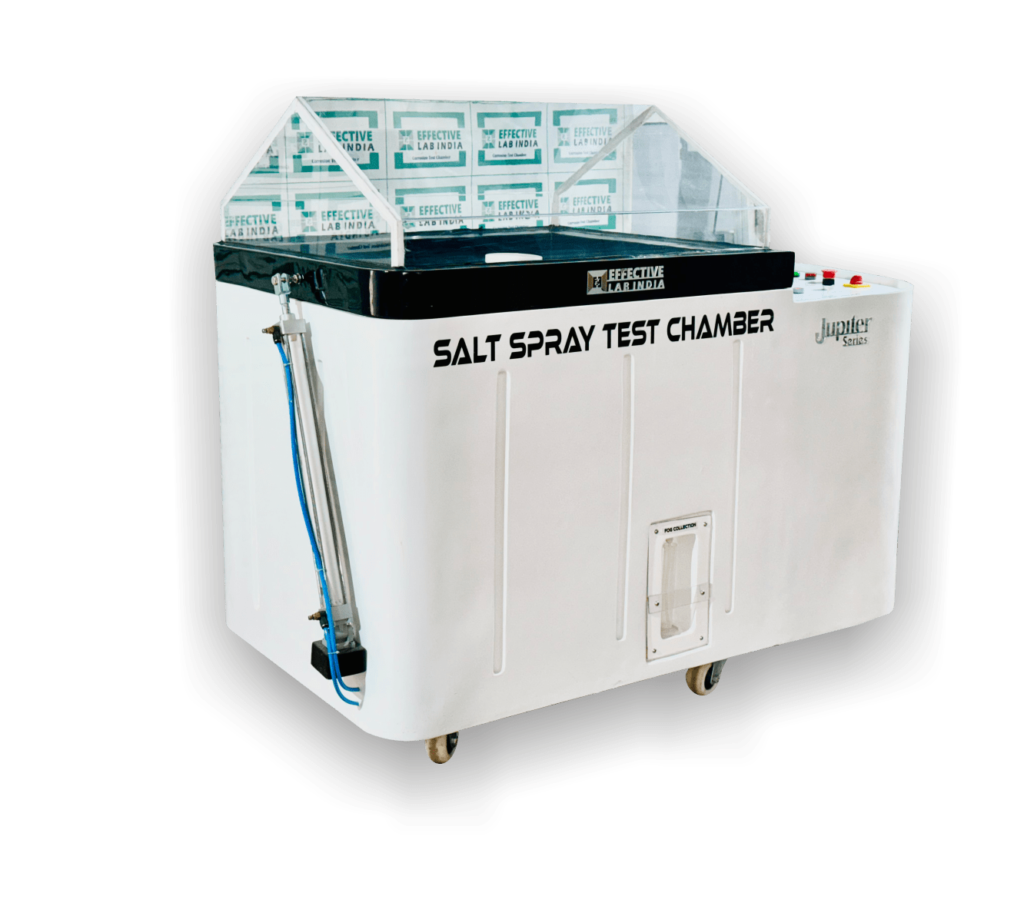

Model – ELI-SST-D250 Ltr, ELI-SST-D450 Ltr, ELI-SST-D1000 Ltr
Salt Spray Tester Manufacturer in India
Laboratory Testing Instruments offers high-quality Salt Spray Testers designed for corrosion resistance testing of metals, protective coatings, and surface-treated components. These testing machines help manufacturers and quality control laboratories evaluate the durability of materials under controlled salt spray conditions. Designed for reliable performance and consistent testing, our equipment supports the quality assurance requirements of various industries.
A Salt Spray Testing Machine is used to assess the corrosion resistance of metals, painted surfaces, electroplated components, and other protective coatings. It produces a controlled salt mist inside the testing area to simulate corrosive environments. This testing method is widely used in the automotive, aerospace, marine, electronics, metal finishing, and coating industries to evaluate material performance and coating quality.
Corrosion can affect the strength, appearance, and service life of metal components exposed to moisture and salt. Our Salt Spray Testers are designed with digital temperature controls, a durable construction, and a convenient viewing window for monitoring the testing process. Depending on the model and configuration, the equipment can accommodate different testing requirements and sample sizes.
Our Salt Spray Testing Machines can be configured for applicable corrosion testing standards, including ASTM B117 and ISO 9227, subject to the selected model and test method. Common neutral salt spray testing conditions include a temperature of approximately 35°C and a 5% sodium chloride solution. Actual test parameters depend on the applicable standard and testing procedure.
Laboratory Testing Instruments focuses on providing dependable corrosion testing equipment for industrial quality control and laboratory applications. Contact us to explore suitable Salt Spray Tester models, technical specifications, and pricing according to your testing requirements.
Description
Features
Specification
Description
Importance of Test Standards in Salt Spray Testing
Salt spray testing standards help laboratories and manufacturers evaluate the corrosion resistance of metals, protective coatings, and surface finishes under controlled conditions. Following the appropriate testing method helps maintain consistency, repeatability, and reliable evaluation of test specimens.
Understanding ASTM B117
ASTM B117 is a widely recognized standard practice for operating salt spray (fog) testing equipment. It describes the conditions and procedures used to conduct neutral salt spray tests for evaluating the corrosion resistance of metallic materials and protective coatings.
The standard provides guidelines for test equipment operation, salt solution preparation, specimen positioning, and maintaining appropriate test conditions. Following the prescribed procedure helps laboratories conduct tests consistently and assess the performance of different materials and coatings.
During and after testing, specimens are examined for visible signs of corrosion, blistering, coating deterioration, or other specified changes. The evaluation criteria depend on the product requirements and the applicable acceptance standards.
ISO 9227: International Standard for Salt Spray Testing
ISO 9227 specifies methods for conducting salt spray tests to evaluate the corrosion resistance of metallic materials with or without corrosion protection. It is widely used by manufacturers, testing laboratories, and quality control departments across different industries.
The standard includes several testing methods:
Neutral Salt Spray (NSS): Used to evaluate the corrosion resistance of metallic materials and protective coatings under neutral salt spray conditions.
Acetic Acid Salt Spray (AASS): Uses an acidified salt solution for testing specified metallic coatings.
Copper-Accelerated Acetic Acid Salt Spray (CASS): Uses a copper-containing, acidified salt solution for accelerated testing of certain decorative and protective coatings.
ISO 9227 and ASTM B117 serve different standardization systems, and the appropriate method should be selected according to the material, coating, and testing requirements.
What Is the Salt Spray Test Procedure?
The salt spray test procedure involves exposing prepared test specimens to a controlled mist of salt solution using a Salt Spray Tester. The equipment maintains specified environmental conditions so that the corrosion resistance of materials and coatings can be evaluated under a defined laboratory test method.
The process generally involves preparing the specimens, preparing the salt solution, positioning the samples, setting the required operating conditions, and conducting the test for the specified duration. After testing, the specimens are examined according to the relevant evaluation criteria.
Salt spray testing is commonly used in the automotive, aerospace, marine, electronics, metal finishing, and surface coating industries. It supports quality control, coating development, and comparative corrosion resistance assessment.
Understanding the Mechanism of Salt Spray Corrosion
Salt spray corrosion testing evaluates how metallic materials and protective coatings respond to a controlled saline environment. When moisture and dissolved salts come into contact with susceptible metal surfaces, electrochemical reactions can cause corrosion and deterioration.
A Salt Spray Tester creates a controlled salt mist that exposes test specimens to specified conditions. This process helps laboratories identify coating defects, evaluate corrosion resistance, and compare the performance of different surface treatments.
The results should be interpreted according to the selected test standard and product-specific requirements. Salt spray test results do not necessarily predict the exact service life of a material in real-world conditions.
Key Features of a Salt Spray Tester
Water-Resistant Construction: The equipment is designed to contain the salt solution and manage condensation and drainage during testing.
Tower Spray System: Depending on the model, a spray tower or atomization system distributes the salt mist throughout the testing area.
Temperature Control: The working area and saturated air system use temperature controls to maintain the conditions required by the selected test method. Some models offer a working temperature range from approximately 5°C above ambient temperature to 50°C, with a saturated barrel temperature range of approximately 40°C to 63°C. Actual ranges must be confirmed from the product specifications.
Test Duration Control: A programmable timer can support extended testing cycles. Certain models may provide settings from 0 to 99,999 minutes.
Multiple Testing Methods: Depending on the equipment configuration, the tester may support NSS, AASS, or CASS testing. Compatibility should be confirmed before selecting a model.
Compliance with Salt Spray Testing Standards
Laboratory Testing Instruments offers salt spray testing equipment intended for corrosion testing applications. The applicable standards and supported test methods depend on the selected model, configuration, and test requirements.
Relevant standards include:
ASTM B117: Standard Practice for Operating Salt Spray (Fog) Apparatus.
ISO 9227: Corrosion Tests in Artificial Atmospheres — Salt Spray Tests.
JIS Z 2371: Japanese standard relating to salt spray testing.
IEC 60068-2-11: Environmental Testing — Test Ka: Salt Mist.
Always verify the required standard and the equipment’s documented capabilities before conducting a compliance test.
What Is a Salt Spray Test?
A salt spray test is a laboratory method used to evaluate the corrosion resistance of metals and protective coatings. A Salt Spray Testing Machine exposes specimens to a controlled saline mist for a specified period to assess their response to corrosive conditions.
This testing method is particularly useful for products that require corrosion resistance, including automotive components, fasteners, electroplated parts, painted surfaces, and industrial coatings. It helps manufacturers assess coating performance, identify potential defects, and improve quality control.
The test duration
Features
- Testing of Various Metal Grades.
- Digital Controls for Effective Operation.
- Highly Accurate Test Results.
- Rugged Structure for Effective Testing.
- Easy Data Management.
- Compliance with Industrial Standards.
- Timer Functions for Accuracy.
- Temperature Control.
- Transparent Canopy.
Specification
| Power | 220V, Single phase, 50Hz, 15 A |
| Test Air Pressure | 0.7kg/cm²-1.2kg/cm² |
| Test Chamber Temperature Range | 35°C ± 2°C |
| Chamber Temperature List Count | 0.1°C |
| Temperature Control | Inbuilt PID Temperature Controller |
| pH value of Salt Solution | 6.5 to 7.2 pH |
| Air Saturator Temperature Least Count | 0.1ºC |
| Air Saturator Temperature Repeatability | ± 2ºC |
| Models | |
| 1 | Digital – 250 |
| 2 | Digital – 450 |
| 3 | Digital – 1000 |
| Inner Dimensions (mm) | Outer Dimensions (mm) |
| 780X620X720 | 1540x1070x1300 |
| 950x700x720 | 1800x1250x1250 |
| 1500x960x710 | 2370x1400x1350 |
Get In Touch
FAQ's
A Salt Spray Tester is a specialized testing instrument used to evaluate the corrosion resistance of materials and protective coatings. It generates a controlled salt mist to simulate corrosive conditions, such as those found in marine environments. Test specimens are exposed to the salt mist for a specified period and then inspected for rust, corrosion, or coating damage.
We do salt spray testing to see if materials and coatings can handle tough conditions. They must do so without getting rusty. It’s like a real-life test to see how they hold up against corrosion.
A Salt Spray Tester consists of a testing enclosure, a salt solution tank, spray nozzles, a temperature control system, an air saturation system, and a digital control panel. These components work together to generate a controlled salt mist and maintain the required testing conditions for evaluating the corrosion resistance of metals and protective coatings.
During salt spray testing, the main evaluation parameters include red rust formation, white corrosion, coating damage, corrosion severity, and time taken for corrosion to appear. These observations help assess the corrosion resistance and durability of materials and protective coatings under controlled test conditions.
The cost of a salt spray test chamber in India can range from several thousand to tens of thousands of dollars, depending on factors such as the brand, size, and features of the chamber.