
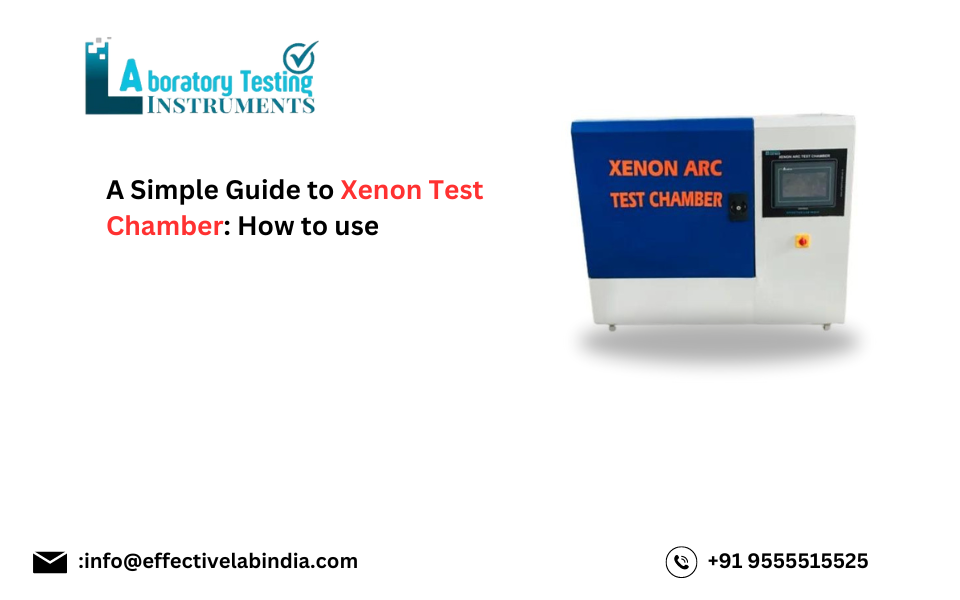
How Does a Xenon Arc Testing Chamber Work: You might be any are a manufacturer of paints, polymers, coatings, plastics, or any material that is exposed to outdoor elements, then understanding how it can perform against sunlight exposure, heat, and moisture conditions, before you send out the material to customers. And that’s what a Xenon Arc Testing Chamber is built for.
Common across industries like automotive, aerospace, construction, and consumer goods, this specialised apparatus can simulate decades’ worth of real-world exposure in days or weeks. In this guide, we take you through the entire process — from preparing your samples to analyzing your results — allowing you to understand exactly what is happening inside this incredible machine.
What is a Xenon Arc Testing Chamber?
A Xenon Arc Test Chamber is a controlled laboratory tool that mimics the effects of sunlight, temperature, and humidity on materials. In contrast to outdoor exposure testing, which can take years before it generates valuable data, the chamber produces results at a faster pace by subjecting specimens to high-intensity xenon arc light that closely approximates the total solar spectrum — ultraviolet (UV), visible, and infrared radiation.
These kinds of chambers are used by engineers and quality assurance people to test durability, colorfastness, and resistance to degradation. The technology is standardized with international test methods, namely ISO 4892-2, ASTM G155, and SAE J2412, so results are universally comparable.
Step 1 — Get Your Supplies & Set Up Your Space
Preparation is all-important before testing begins. First, define the test specimens — these could be paint panels, plastic sheets, rubber components, textiles, adhesives, or any other materials that need to be evaluated. Cut or otherwise prepare specimens to the sizes specified by your testing standard — generally rectangular panels sized to fit into your chamber’s rotating drum or flat rack.
Safety comes first. Xenon arc lamps generate intense radiation, and the chamber environment is relatively high temperature/humidity. When handling equipment, you should always be wearing UV-protective safety glasses and heat-resistant gloves. Test in a well-ventilated area, and only trained individuals should operate the machine.
Step 2 — Load the Xenon Arc Testing Chamber in the Right Way
The accurate placement of your sampling has a direct impact on the validity of your results. Secure your specimens on the sample holders in the chamber. Most test-chambers use a revolving carousel to provide each sample equal time in the focus of the xenon arc lamp at their center. Ensure each panel is flush and stable — gaps or misalignment can lead to uneven light distribution, which will spoil your data.
It’s a good idea to run a reference standard along with your test specimens as well. This can be something you have previously tried out on a panel like this for, or just a control material with known degradation behavior that gives you a stable baseline to compare against.
Step 3 — Define Parameters for the Test
That’s where the science gets specific.
The Xenon Arc Testing Chamber used in our labs can replicate a variety of environmental factors to accurately simulate the conditions a product will experience during in-use applications. Key parameters include:
Xenon Arc light irradiance level (W/m²): The intensity of the xenon arc light is adjusted to reach the target test standard.
- Temperature: The black standard temperature (BST) or black panel temperature (BPT) may be set so it only applies to hotter climates, moderate environments, or cold-weather conditions.
- Humidity and water spray cycles: Intermittent water sprays mimics rain, morning dew, and moisture exposure, which are vital variables in testing coatings and sealants.
- Test Length: A test cycle can operate for a few hours based on your objective, and perhaps thousands of hours. Longer runs represent simulated added years of outdoor service life.
Many contemporary chambers have programmable controllers, allowing you to automatically alternate between light-only cycles and dark/moisture cycles to simulate day-and-night weathering sequences.
Step 4 — Start the Xenon Arc Testing Chamber
After setting your parameters, seal the internal environment by firmly closing the chamber door. Make sure all sensors — temperature probes, irradiance monitors, and humidity detectors — are reporting correctly before starting the cycle.
Activate the xenon arc lights. These lamps emit a wide range of light that is filtered (with borosilicate or quartz internal and external filters) to resemble natural sunlight at the surface of the Earth more closely. The result is an extremely precise reconstruction of solar radiation that induces the same type of photochemistry in your material as long sun exposure would in the field.
The chamber will start cycling automatically through your programmed sequence.
Step 5 — Monitor the Process
The chamber works autonomously for the most part, but needs to be monitored from time to time. Use regular checks by the control panel or connected software to ensure that irradiance, temperature, and humidity are all between tolerance limits.
Most xenon arc weathering test chambers in use today feature digital dashboards or PC-connected logging software that captures real-time data for the duration of the test. This is essential for documentation, compliance reporting, and reproducibility.
WARNING: The interior of the appliance gets hot during use. Never open the chamber door without checking for the temperature first and letting it cool down a bit if necessary.
Step 6 — Remove Samples and Document Changes
At the conclusion of the test cycle, turn off the lamp system and allow the chamber to cool down to a temperature safe for handling.
Using heavy-duty, heat-resistant gloves, gently remove each specimen. Lay them on a clean, flat surface and assess right away — or stash them in a dark, controlled atmosphere to prevent more light exposure until you can analyze them.
These include visible signs of degradation, such as:
- Fading or yellowing of color (using a spectrophotometer)
- Surface chalking or hazing
- Cracking, flaking, or blistering
- Gloss loss (measured with a gloss meter)
- Changes in flexibility or brittleness
The analogue can do better with visual documentation, such as sample tubes, before testing and after the sampling process. Use accurate, calibrated instruments for quantitative measurements, so you have objective,e repeatable raw data that can be sent to clients, regulators, rs or your own R&D team.
Step 7 — Analyze and Use Your Results
The final and most useful stage of this process is transforming raw observations into actionable insight.
Each tested specimen should be compared to your control or baseline sample. Compute the average hue change (or ΔE values), gloss retention, tensile strength, or whatever figure is most linear from your product performance specifications;
This analysis allows manufacturers to:
- Identify formulations that outperform competitors
- Statistical confidence on product lifespan in the real world
- Develop specific enhancements before large-scale deployment
- International market certification and compliance
- The Xenon Arc Lamp Aging Test Chamber against Product Testing
The aging test chamber is not just for quality control, but also a strategic part of product innovation. R&D teams utilize it to quickly screen new raw materials, compare supplier formulations, and validate product changes without having to wait years for data from the field.
An automotive coating, for example, needs to withstand 10 years of sun exposure in Arizona; that can be tested and reworked in a matter of weeks. A plastics manufacturer designing outdoor furniture components can easily and cost-effectively compare UV stabilizer packages against each other.
The xenon arc lamp aging test chamber is essentially a time machine — enabling manufacturers to release products that are better and stronger without sacrificing speed, and with durability claims that hold water.
Suggested Post:
Best Salt Spray Chamber in India
Understanding UV Light Accelerated Weathering Test Chambers
Final Thoughts
The Xenon Arc Testing Chamber is among the most trusted and scientifically rigorous methods of analysis available for material weathering. By accurately replicating solar radiation, heat, and humidity, it provides engineers and manufacturers with key data to build products that last.
Regardless of whether you’re testing architectural coatings, automotive finishes, outdoor plastics, or industrial sealants, a structured and well-verified test protocol will ensure your results are accurate, repeatable,e and meaningful.
Always use the equipment under the supervision of qualified personnel, and in strict accordance with applicable test standards. In fact, good science is built on a foundation of good process.