The paper and packaging industry operates in a highly competitive environment where product quality, durability, and compliance are non-negotiable. Whether you are manufacturing corrugated boxes, kraft paper rolls, or multi-layered packaging materials, the ability to verify structural integrity before products reach the market is essential. One of the most critical instruments that supports this goal is the Bursting Strength Tester.
This guide provides a comprehensive price comparison of Bursting Strength Testers across different segments of the paper and packaging industry, while also exploring how related instruments — the Box Compression Tester and GSM Round Cutter Machine — contribute to a complete quality assurance workflow. If you are evaluating your packaging testing setup, this article will help you make an informed investment decision.
Bursting Strength Tester Applications in Paper & Corrugated Box Testing
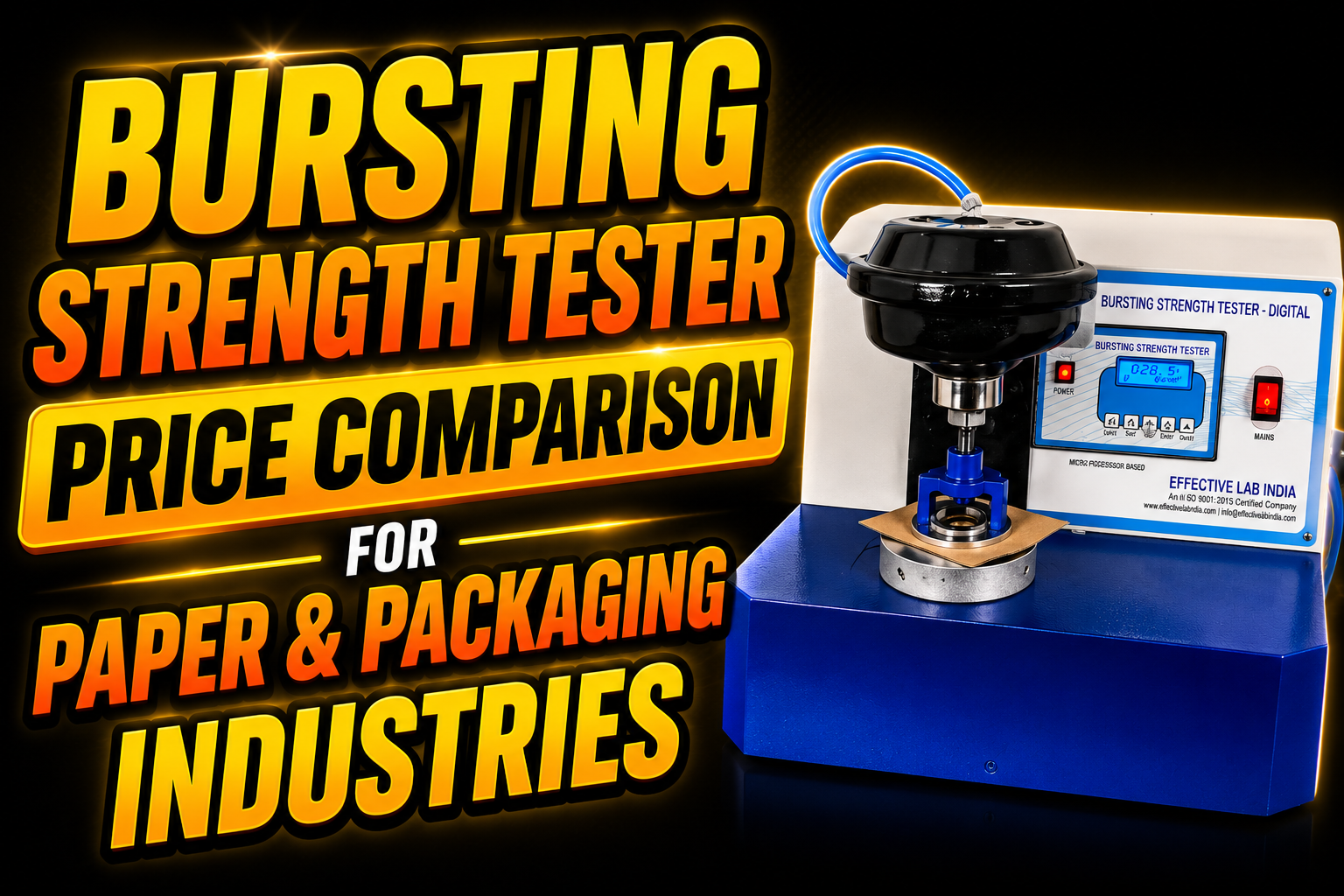
A Bursting Strength Tester measures the amount of pressure a material can withstand before it ruptures. It evaluates the resistance of paper, paperboard, corrugated sheets, woven sacks, and other packaging substrates to a uniformly increasing pressure applied through a rubber diaphragm. The result is expressed in kPa (kilopascals) or kgf/cm², and it forms a core metric in paper quality standards such as BIS IS 1060, TAPPI T403, and ISO 2759.
In the corrugated box manufacturing sector, bursting strength is used to evaluate the raw fluting medium, liner, and finished box board. A higher bursting strength indicates better load-bearing capacity and resistance to rough handling during transit. For e-commerce packaging, this becomes especially critical because boxes are subjected to multiple drops, stacking, and compression stress throughout the supply chain.
Bursting Strength Testers are used in the following applications:
- Kraft paper testing to verify that packaging paper meets strength thresholds for export compliance
- Corrugated sheet testing to validate the quality of both single-wall and double-wall corrugated boards
- Woven sack evaluation for fertilizer, cement, and agro-packaging industries
- Tissue and specialty paper testing for quality grading before dispatch
- Incoming material inspection in converting units that source raw paper from third-party mills
Price Range and What Affects the Cost
The price of a Bursting Strength Tester varies significantly depending on the model type, capacity range, automation level, and brand origin. In the Indian market, prices generally range from approximately ₹25,000 to ₹2,50,000 or more, depending on the configuration:
- Manual hydraulic models are the most affordable and are suitable for small-scale paper mills and job shops.
- Digital semi-automatic models with microprocessor-based display and auto-reset functionality fall in the mid-range and are preferred by medium-sized packaging converters.
- Fully automatic pneumatic or motorized models with PC connectivity, USB data output, and multi-sample averaging are positioned at the premium end and are used in large manufacturing plants and accredited testing laboratories.
International brands such as those from Germany, the UK, or the USA are priced higher due to import duties and after-sales support costs. Indian manufacturers offering NABL-compatible and ISO-calibrated models provide a cost-competitive alternative with reliable performance.
Box Compression Tester vs Bursting Strength Tester: Key Differences
A common question among packaging professionals is whether a Box Compression Tester (BCT) can replace a Bursting Strength Tester, or vice versa. The short answer is no — these instruments test fundamentally different mechanical properties and serve complementary roles in a packaging quality program.
What a Box Compression Tester Measures
A Box Compression Tester applies a controlled vertical load to a finished corrugated box and measures the maximum compressive force the box can withstand before it collapses. This test directly simulates warehouse stacking conditions where multiple cartons are piled on top of each other for extended periods.
The BCT test result is critical for logistics planning. It tells packaging engineers whether a box design is structurally capable of supporting a defined stacking load without collapsing. Standards such as ASTM D642 and TAPPI T804 govern this test.
What a Bursting Strength Tester Measures
The Bursting Strength Tester evaluates the material-level strength of the substrate — the paper or board — rather than the finished box. It answers the question: “Is the raw material strong enough to begin with?” It is primarily a raw material acceptance test.
Side-by-Side Comparison
| Parameter | Bursting Strength Tester | Box Compression Tester |
|---|---|---|
| Test Object | Paper, board, corrugated sheet | Finished corrugated box |
| Property Measured | Resistance to bursting pressure | Compressive load capacity |
| Stage of Use | Incoming raw material inspection | Finished goods quality check |
| Output Unit | kPa or kgf/cm² | Newton (N) or kgf |
| Standards | TAPPI T403, ISO 2759, BIS IS 1060 | ASTM D642, TAPPI T804 |
| Approximate Price Range (India) | ₹25,000 – ₹2,50,000+ | ₹80,000 – ₹5,00,000+ |
For a packaging manufacturer that operates end-to-end — from paper procurement to box manufacturing — investing in both instruments ensures complete quality control coverage. Relying on only one leaves critical gaps in your quality data.
Which Is Better for Your Application?
If you are a paper mill or raw material supplier, a Bursting Strength Tester is your primary instrument. If you are a box manufacturer sending finished products to FMCG, pharmaceutical, or e-commerce clients, a Box Compression Tester is indispensable. If you are an integrated packaging plant, both instruments work in tandem to deliver a comprehensive quality assurance program.
How GSM Round Cutter Machines Improve Paper Testing Accuracy
No paper or packaging testing workflow is complete without accurate specimen preparation. This is where the GSM Round Cutter Machine plays a vital — yet often underestimated — role.
GSM (Grams per Square Metre) is a fundamental property of paper that directly correlates with its weight, strength, and cost. Testing GSM requires cutting precise circular samples of a defined area — typically 100 cm² — which are then weighed on a precision balance to calculate the GSM value.
The Importance of Precision Cutting
Inaccurate specimen cutting introduces significant errors in GSM calculation. If the cut area is even slightly smaller or larger than the standard 100 cm², the resulting GSM value will be incorrect. This leads to:
- False compliance reports that may not reflect the actual paper grade
- Overpayment for substandard paper if you are a buyer
- Disputes with clients if you are a supplier
- Calibration discrepancies when comparing data across different test dates
A GSM Round Cutter Machine uses a hardened steel circular blade with a precisely engineered cutting diameter, ensuring that every sample cut is exactly the same size. High-quality models feature a handle-press mechanism that applies uniform pressure and eliminates operator dependency on the cut accuracy.
How It Supports Bursting Strength Testing
The link between GSM and bursting strength is well established. Paper with higher GSM generally exhibits greater bursting strength, assuming consistent manufacturing quality. When your GSM measurements are accurate, you can build reliable correlations between material weight and strength performance — which is essential for incoming raw material specification compliance.
For example, a paper mill that supplies 90 GSM kraft liner should consistently deliver material meeting a specified minimum bursting strength value. By tracking both GSM and bursting strength together, buyers can detect quality deviations early, before the material is processed further into boxes.
Price and Variants of GSM Round Cutter Machines
In the Indian market, GSM Round Cutter Machines are available across two broad segments:
- Standard manual models are priced between approximately ₹3,000 and ₹8,000 and are suitable for most factory testing environments.
- Heavy-duty precision models with stainless steel platforms, ergonomic grip designs, and multiple cutting die options can range from ₹10,000 to ₹25,000.
Some advanced models include multiple interchangeable die sizes to allow cutting of samples with areas other than 100 cm², which is useful for specialty paper testing and research laboratories.
Integrated Benefits in a Testing Setup
When a GSM Round Cutter Machine is used alongside a Bursting Strength Tester and a precision analytical balance, the laboratory gains a three-instrument setup capable of generating comprehensive incoming inspection data. This setup is compact, cost-effective, and suitable even for small and mid-sized packaging factories.
Conclusion: Benefits of Investing in Reliable Packaging Testing Instruments
Investing in high-quality packaging testing instruments is not simply a compliance requirement — it is a strategic business decision that impacts product reliability, customer trust, and long-term cost control.
Here is a summary of the key benefits:
Reduced rejection and rework costs. Catching raw material defects early through bursting strength and GSM testing prevents costly production rejects and client returns downstream.
Stronger supplier accountability. With documented test data, buyers can hold paper and board suppliers to clearly defined specifications. Disputes over material quality are resolved objectively, not anecdotally.
Compliance with international standards. Export-oriented packaging manufacturers who supply to markets in Europe, the USA, or the Middle East must meet specific testing requirements. Instruments calibrated to standards like TAPPI, ISO, and ASTM provide credible evidence of compliance.
Better box design decisions. Data from Box Compression Testers, combined with material-level bursting strength figures, allows packaging engineers to optimize box design for both strength and material economy.
Building customer confidence. When brands choose packaging suppliers, they increasingly demand test reports and quality documentation. A well-equipped testing laboratory positions your business as a serious, quality-first manufacturer.
Whether you are setting up a new paper testing lab from scratch or upgrading your existing equipment, a thoughtful combination of a Bursting Strength Tester, Box Compression Tester, and GSM Round Cutter Machine will serve as the backbone of a robust packaging quality system. Prioritize instruments from manufacturers who offer calibration certificates, after-sales service, and compliance with recognized testing standards for maximum long-term value.
FAQs
What factors affect the price of a Bursting Strength Tester?
Several factors influence the pricing of a Bursting Strength Tester. The type of operation (manual, semi-automatic, or fully automatic) has the greatest impact on cost, with automatic models commanding significantly higher prices due to motorized clamping, digital displays, and data output features. The pressure range and capacity of the instrument also affects pricing — heavy-duty models capable of testing high-GSM boards cost more than entry-level units. Brand and country of origin play a role as well, with European and North American brands typically priced higher than domestically manufactured alternatives. Additional factors include calibration certification, availability of after-sales service, compliance with specific international standards, and any custom features such as PC software integration or multi-user data logging. It is advisable to evaluate the total cost of ownership — including calibration, maintenance, and spare parts — rather than the purchase price alone.
Which is better for packaging quality testing: a Bursting Strength Tester or a Box Compression Tester?
Neither instrument is universally better — they measure different properties and serve different stages of the quality control process. A Bursting Strength Tester is essential at the raw material inspection stage, verifying that incoming paper and board meets the required strength before it is converted into packaging. A Box Compression Tester is used at the finished goods stage to confirm that the completed box can withstand the compressive loads it will experience during storage and shipping. For packaging manufacturers who both procure raw materials and produce finished boxes, investing in both instruments provides end-to-end quality assurance. If budget is a constraint and only one instrument can be purchased initially, the choice depends on your position in the supply chain — raw material suppliers should prioritise the Bursting Strength Tester, while box manufacturers serving logistics-intensive industries should prioritise the Box Compression Tester.
Why is a GSM Round Cutter Machine important for the paper and packaging industries?
A GSM Round Cutter Machine ensures that paper specimens are cut to a precise, standardised area before GSM testing. Since GSM is calculated by dividing the weight of a sample by its area, any error in cutting directly causes an error in the GSM result. Consistent and accurate GSM measurement is important because it determines whether incoming paper meets the contracted weight specification, confirms that manufactured paper falls within the target grade range, and provides the baseline data needed to correlate paper weight with mechanical properties such as bursting strength and tensile strength. In addition, regulatory and export documentation often requires GSM certifications from accredited testing sources, making accurate specimen preparation a prerequisite for credible test results. A reliable GSM Round Cutter Machine is a low-cost but high-impact investment that significantly improves the accuracy and repeatability of your overall paper testing program.