Edge Crush Test Calculator: A box that buckles under stacking pressure, humidity, or transport vibration doesn’t only ruin products — it ruins brands. The Edge Crush Test calculator is aimed at engineers, quality managers, and procurement teams who need to make quick data-driven decisions about the performance of corrugated boards rather than guessing.
We at Effective Lab India deal with manufacturers across the spectrum — from e-commerce to FMCG to help them bring order in their packaging quality control. This guide runs you through how the ECT calculator works, what parameters are responsible for influencing box compression test results, and how to choose the right instrument for a production environment.
Edge Crush Test Calculator for Manufacturers That Save Time and Improve Accuracy
The Edge Crush Test (ECT) describes the compressive strength of corrugated fiberboard when a load is applied to its edge, at 90 degrees in relation to the direction of the board’s flutes. This mimics the weight that a box feels when it is piled on top of something in reality. ECT is rated in kilonewtons per meter (kN/m) or pounds-force per inch (lbf/in), depending on your local standard.
Box Compression Strength (BCT) is generally estimated from core inputs, using the McKee formula or modified versions thereof, and most Edge Crush Test calculators use some variation of this. The classic McKee formula is:
The McKee Formula for Box Compression Strength
- BCT = 5.874 × ECT × √(ECT × h)]
- ECT — Edge Crush Test board value (kN/m)
- h — Caliper (thickness) of the corrugated board (m)
- Z — Box Perimeter (Applicable only in Full McKee Formula variants)
- The output is an estimated compression load in Newtons or pounds-force
A digital ECT calculator helps you to avoid mistakes in mathematical calculations. Quality control engineers can enter test values from their box compression tester in real time, receive immediate BCT predictions, and compare against stacking load requirements for their supply chain. This is vital in high-volume manufacturing because even a 5% variation in board strength might result in expensive returns or failure during transit.
With ECT calculator functionality available on test reports, Effective Lab India’s digital test solutions minimize the time between lab and floor communication. Benefits of Integrating the Right Tools. When your testing undertaking instrumentation is in line with your calculation engine, the accuracy increases, and documentation is ready for audit on day one.
How Box Compression Test Factors Affect Box Strength Performance
The box compression test (BCT) is the measurement of the vertical load that a closed, filled, or empty box can support until it buckles or crushes. Manufacturers can optimize, rather than over-engineer, both box design and board specification (which comes at a significant materials cost) by understanding what factors contribute to BCT performance.
All about Box Compression Test Performance
- Board grade and flute type — B-flute, C-flute, and E-flute all have different compressive responses; C-flute typically provides the greatest balance of rigidity and cushioning
- Moisture content — In the case of corrugated board, ECT (edge crush strength) falls up to or more than 40% if relative humidity exceeds 85% RH; one of the most underestimated variables in real logistics.
- Box geometry and perimeter — Smaller box perimeters relative to board thickness increase buckling resistance; longer perimeters distribute load over more wood, but are also less bendy.
- Printing and scoring – Ink coverage and die-cut patterns decrease effective board strength at creases; manufacturers often neglect post-print loss of strength
- Stacking configuration — Aligned stacking vastly outperforms brick-pattern stacking; warehouse stacking protocols need to match the BCT assumptions in the box specification
Test speed and platen alignment – The accuracy of equipment calibration and test speed has a direct impact on the BCT results. TAPPI T804 and ISO 12048 document standard testing parameters specific to BCT that must be followed.
From our collaboration with packaging labs throughout India and Southeast Asia, we found the most frequent failure mode is not weak boards — it’s not simulating real-world conditions vs. tested conditions. A box compression tester measures performance under specific conditions, at a single point in time. The Edge Crush Test calculator then predicts expected field performance. The two tools together show the full story.
In high-humidity storage environments, Effective Lab India suggests that testing of samples conditioned at 23°C / 50% RH (standard atmosphere) and at higher humidity is advised as well to allow engineers to record the loss in strength and to factor a safety margin into design. Most international logistics standards mandate a safety factor of 4 to 6 times the actual payload weight when it comes to box BCT — and that number needs to be based on reliable, well-calibrated test data.
How to Choose the Right Tester for Your Business That Improves Quality Control
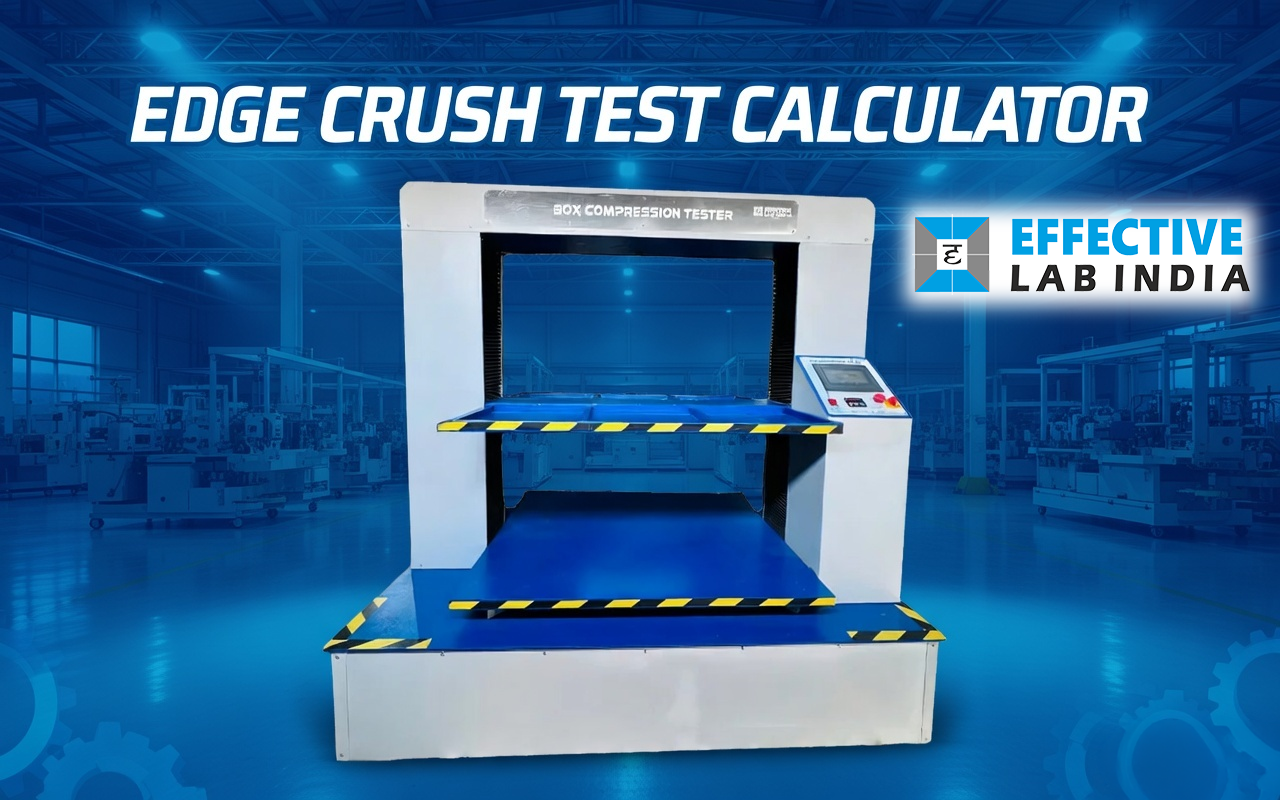
When choosing the best box compression tester for your facility, there are three main considerations: test volume, standards requirements, and integration with your quality management system. The price expectations for the box compression tester at each performance tier guide you in building a business case for the investment.
Corrugated board compression testers of three types
- Entry-level manual systems (₹80,000–₹2,00,000): Best for small manufacturers or suppliers who perform less than 20 tests in a week. They measure BCT with confidence, but no automatic force reading and data logging are possible. Best suited for job shops and smaller corrugated converters
- Semi-automated digital testers (₹2,00,000 to ₹5,00,000): Use digital load cells for measurement of force and provide automatic peak-force detection along with USB or RS-232 output data transfer. This encompasses the majority of mid-scale packaging plants, e-commerce fulfillment operations, and pharma secondary packaging labs. The instruments conform to ISO 12048 and TAPPI T804 specifications.
- Fully Automatic Programmable Testers (₹5,00,000 and above): These provide motorized platens, programmable test speed, PC software with statistical analysis, and multi-standard compliance. Best suited for large box manufacturers in the corrugated space, third-party testing laboratories, and any export operations needing full traceability.
Apart from the price of the box compression tester, its quality is also a very crucial factor that determines long-term value. Genuine spare parts, calibration traceability to NABL-accredited standards, after-sales service turnaround time (both response and onsite), and software update support all contribute to the total cost of ownership over a typical instrument lifetime of 5–10 years.
Edge Crush Test calculator workflow & Complete Calibration
We offer box compression testers that comply with BIS, ISO, TAPPI, and ASTM standards, along with a complete calibration certificate at Effective Lab India. Our instruments are fully integrated with the Edge Crush Test calculator workflow, allowing lab results to flow effortlessly into your packaging specification database. For example, whether you are a corrugated board manufacturer testing the incoming quality of raw material or an OEM packaging avenue qualifying secondary packaging for international shipment, we have instruments calibrated to your specific standard and production scale.
We are also entitled as the India dealer for installing, user training, and AMC. As with any tester, always demand a live demonstration on your own sample material — paper and board variability means no two factories can have the same baseline performance, and a properly specified tester should be verified against your actual range of products.
The Edge Crush Test calculator is more than a mathematical convenience — it’s an essential decision-support tool that connects lab tests to functional performance of packages in the marketplace. When combined with a properly calibrated box compression test device, it allows manufacturers to reduce material costs and eliminate field failures, in addition to meeting the increasing documentation demands of modern retail and e-commerce supply chains. An effective Lab India helps manufacturers at every scale in making that process accurate, efficient, and with complete standard compliance.
Frequently Asked Questions
Edge Crush Test Calculator: What is this?
An Edge Crush Test calculator takes the ECT value of a corrugated board — measured by compressing a sample edge-on — and combines it with board caliper and box geometry to approximate Box Compression Strength (BCT) using formulas such as the McKee equation. It translates raw lab measurements into a predicted load-bearing capacity for a commercially assembled box, and helps packaging engineers validate designs without the need to physically construct and test every prototype.
Which one is better, the Edge Crush Test and Box Compression Test?
It is a small strip of corrugated board, and it measures the material properties, which are inherent compressive strength of the corrugate. Box Compression Test (BCT: a test of a complete, assembled box that helps determine how much load it can support before collapsing. ECT is a material-level test; BCT is a finished-product test. Thus, the ECT value is incorporated in the BCT prediction through a calculator formula, which means together they are complementary tools used in packaging quality flow.
What is the Box Compression Tester cost in India?
India box compression tester price ranges from around ₹80,000 for basic manual systems to over ₹5,00,000 for fully automatic PC-integrated systems. Standard ANSI semi-automatic digital tester in the price range of ₹2,00,000 to ₹5,00,000 with ISO 12048 & TAPPI T804 certified. Which you choose depends on test volume, compliance needs, and software integration with your QMS system. Effective Lab India provides all tiers’ instruments with total calibration certification.
How does Relative Humidity Impact Box Compression Test Results?
BCT performance has one of the most important variables, with humidity. Corrugated board can lose as much as 40% of its compressive strength when stored or transported in conditions above 85% relative humidity. This is the reason that international packaging standards specify that samples need to be conditioned at 23° C / 50% RH before testing. For products that will be transported to high-humidity locations or dry-volatile air-conditioned and refrigerated supply chains, vigorous testing for upper humidity climates and a sensible safety factor should be used.
Edge Crush Test? Box Compression Test? What are the international standards governing these tests?
The principal Edge Crush Testing standards are ISO 3037 and TAPPI T811 — they specify sample preparation, conditioning, and the test itself. ISO 12048 and TAPPI T804 are International Standards for Box Compression Testing. BIS standards are applicable for domestic certification in India as well. The instruments from Effective Lab India are manufactured by companies that were purposely designed and calibrated in accordance with all four frameworks, thereby making sure that your test data is accepted by not only local regulatory bodies but also overseas retail & logistics partners.