
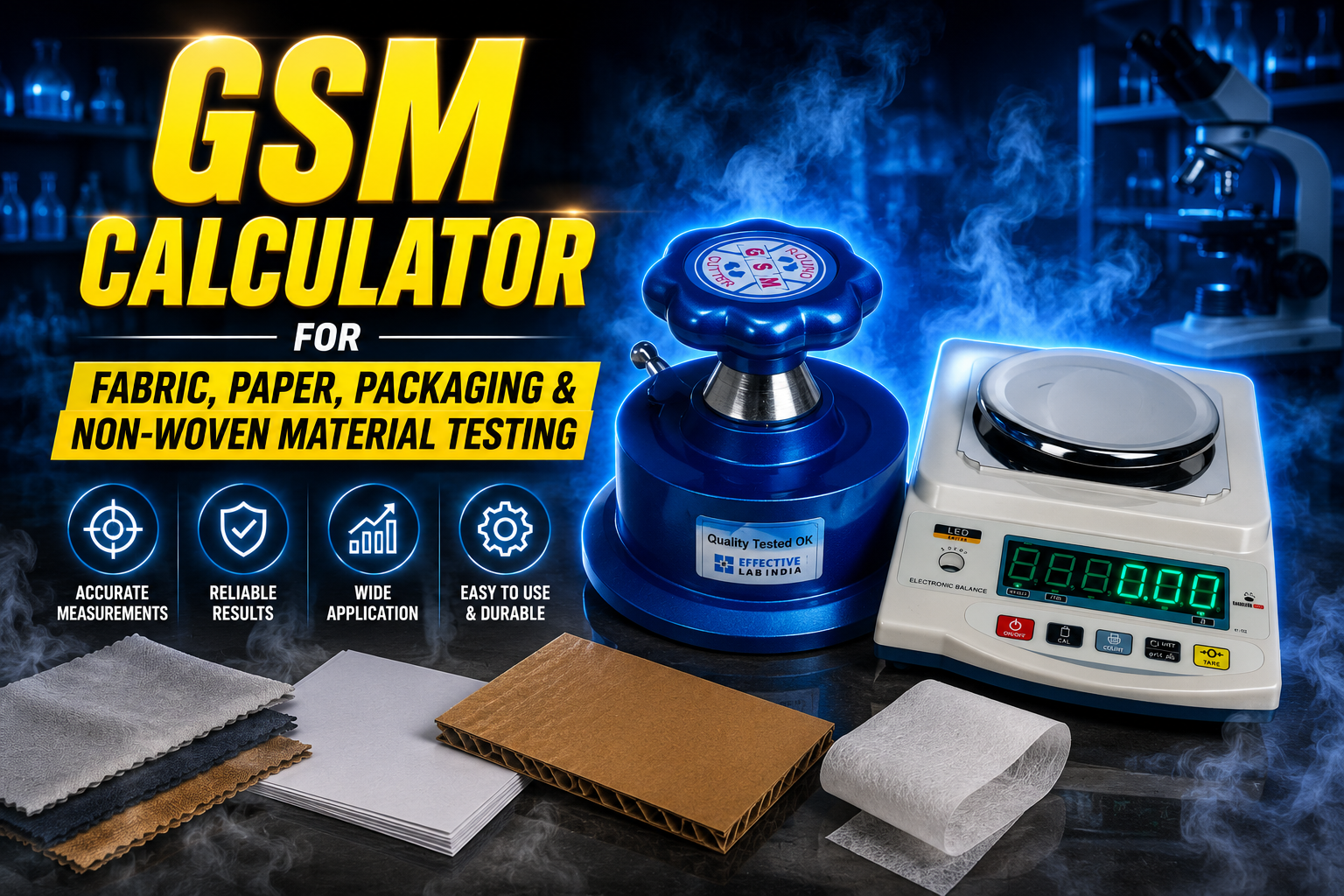
In this era of stiff competition within manufacturing and quality control practices, precision is not a mere option but a necessity. Whether you are a manufacturer of textiles, paper products, packaging materials, medical supplies, or leather products, there is one parameter that determines the quality of your material, and that is GSM or Grams per Square Meter.
The GSM calculator is a fundamental tool employed in all sectors to quantify the weight of the material per square meter. The GSM parameter plays a significant role in determining the strength, durability, feel, absorbency, and performance of the product. Knowledge on how to calculate GSM and the tools needed for this process can make or break the product in the international market.
This article provides all the information you require concerning GSM calculation of fabrics, paper products, packaging materials, and nonwovens.
What Is GSM and Why Does It Matter?
GSM stands for Grams per Square Meter, and it quantifies the mass of a material relative to its surface area. A higher GSM value indicates a heavier, denser, and often more durable material. A lower GSM points to a lighter, thinner product.
For manufacturers, quality control labs, procurement teams, and compliance officers, GSM is a standardized metric recognized globally under testing frameworks including ISO, ASTM, BIS, and other regulatory bodies.
GSM Calculation Formula
The standard GSM calculation formula is:
GSM = (Weight of Sample in Grams × 10,000) ÷ Area of Sample in cm²
Alternatively, if you’re using a circular cutter to collect your sample:
GSM = Weight of Sample (g) ÷ Area of Cutter (m²)
Most professional GSM testing setups use a circular cutter of a fixed area (typically 100 cm²), a precision weighing balance, and optionally a GSM to micron calculator for conversion when thickness measurement is also required.
Accurate GSM Calculation for Fabric, Cotton, Polyester & Non-Woven Textile Testing
The textile industry is one of the largest consumers of GSM testing equipment. Whether you are testing cotton, polyester, blended fabrics, denim, knitted fabrics, or technical textiles, accurate GSM measurement is foundational to product compliance and buyer satisfaction.
Fabric GSM Calculation Formula
The fabric GSM calculation formula follows the same fundamental principle:
Fabric GSM = (Sample Weight in grams ÷ Sample Area in m²)
In practice, the sample is cut using a standard GSM cutter (usually 100 cm² or 50 cm²), weighed on a digital balance (accurate to 0.001g), and the result is multiplied to arrive at grams per square meter.
For woven fabrics like cotton shirting or polyester suiting, GSM typically ranges between 80 and 200. Denim generally falls in the 280–400 GSM range, while fleece and winter fabrics may exceed 450 GSM.
For knitted fabrics such as jersey and interlock, GSM testing ensures the fabric meets the required density for stretch, recovery, and comfort. Incorrect GSM in knitwear leads to fit failures, pilling, and dimensional instability after washing.
A reliable GSM calculator removes human error from this critical process and ensures results are reproducible, consistent, and audit-ready.
Suggested Post:
What is the Box Compression Test? Machine Types, Price Range & Industrial Uses
Industrial BOD Incubator Diagram: Specifications & Supplier Insights
Measure GSM of Paper, Cardboard, Corrugated Boxes & Printing Paper with Precision
The paper and packaging industry depends on GSM measurement to define product grades and applications. From office printing paper and newsprint to kraft paper, duplex boards, and corrugated boxes, each material type has a defined GSM specification that governs its performance.
Common Paper GSM Ranges
| Paper Type | Typical GSM Range |
|---|---|
| Tissue Paper | 12–35 GSM |
| Newsprint | 45–55 GSM |
| Standard Printing Paper | 75–90 GSM |
| Offset/Coated Paper | 90–170 GSM |
| Cardboard / Duplex Board | 200–400 GSM |
| Corrugated Medium | 100–200 GSM per ply |
For corrugated box manufacturers, knowing the GSM of each fluting and liner layer is critical to calculating the Box Compression Test (BCT) value and Edge Crush Test (ECT) results. Under-specified GSM leads to structural failure during transit.
Printing companies also rely heavily on GSM testing when sourcing paper stock. Incorrect GSM in brochures, packaging labels, or cartons results in poor ink adhesion, misfeeds in printing machines, and customer rejection.
Using a calibrated GSM calculator with precise sample cutters and analytical balances ensures that incoming material inspections are performed with repeatability and traceability — both requirements under ISO 9001 quality management systems.
Non-Woven & Medical Products: Mask, PPE Kits & Wipes
The COVID-19 pandemic brought unprecedented attention to non-woven materials, especially in the production of surgical masks, N95 respirators, PPE kits, protective coveralls, and medical wipes.
Non-woven fabrics are engineered materials where fibers are bonded through chemical, thermal, or mechanical processes rather than weaving or knitting. Their GSM directly impacts filtration efficiency, fluid barrier performance, and breathability — all critical parameters in medical and hygiene applications.
For face masks, the outer layer, melt-blown filter layer, and inner soft layer each have specific GSM requirements. A melt-blown layer used in surgical masks typically falls in the 18–35 GSM range. The outer spunbond layer is usually 17–25 GSM.
PPE coveralls are tested for GSM to ensure they provide adequate particulate protection without compromising mobility. Wet wipes and baby wipes must hit precise GSM targets to ensure consistent saturation, softness, and structural integrity when pulled from a pack.
Testing these materials with an accurate GSM calculator ensures compliance with WHO guidelines, IS standards, and CE certifications required for export and hospital procurement.
Leather & Footwear Industry: Artificial Leather Applications
The leather and footwear industry — including manufacturers of PU leather, PVC artificial leather, synthetic uppers, and shoe linings — uses GSM measurement to evaluate the weight and consistency of substrate materials.
Artificial leather is a multi-layered composite material, and the GSM of the base fabric, foam layer, and surface coating contributes to the final product’s overall performance. For footwear uppers, a higher GSM typically signals better durability and abrasion resistance. For garment leather, a lower GSM may be preferred for drape and flexibility.
Automotive seat cover manufacturers sourcing artificial leather also specify GSM tolerances in their supplier quality agreements. Any deviation in GSM may result in warranty claims or supply chain rejection.
A precise GSM to micron calculator is also widely used in leather testing labs to correlate material thickness with weight, helping engineers predict mechanical performance before physical wear tests are conducted.
Quality Testing Labs & Industrial Standards
Whether you operate a NABL-accredited testing laboratory, an in-house QC department, or a third-party inspection facility, the tools you use for GSM measurement must meet established performance standards.
Key standards for GSM testing include:
- ISO 536 – Paper and board: determination of grammage
- ISO 9073-1 – Nonwovens: determination of mass per unit area
- ASTM D3776 – Standard test methods for mass per unit area (weight) of fabric
- IS 1964 – Method for determination of mass per unit length and mass per unit area of woven fabrics (BIS Standard)
Labs that follow these standards ensure their results are defensible, reproducible, and internationally comparable. Regulators, buyers, and certification bodies increasingly require documented GSM test reports as part of product conformity assessments.
Modern GSM testing setups integrate precision circular sample cutters (stainless steel, anti-corrosion), analytical balances with 0.001g readability, and digital GSM calculators that auto-compute results and export data to QMS or ERP systems. This eliminates manual transcription errors and speeds up throughput in high-volume testing environments.
Choose Effective Lab India for Reliable & Industry-Grade GSM Calculators
When it comes to sourcing dependable, standards-compliant GSM testing instruments, Effective Lab India is a trusted name among manufacturers, quality labs, and export houses across India and beyond.
Effective Lab India offers a comprehensive range of GSM testing equipment, including circular sample cutters, precision balances, and complete testing kits designed to meet ISO, ASTM, BIS, and Yoast-compliant testing workflows. Their instruments are engineered for durability, accuracy, and ease of use — whether you’re testing fabric, paper, non-woven materials, or artificial leather.
What sets Effective Lab India apart is their focus on industry-specific calibration, technical support, and after-sales service. Their team of material testing experts can guide you in selecting the right GSM calculator configuration for your application — whether you need a basic manual setup or a fully integrated digital solution.
For quality managers who need consistent, auditable results and procurement teams who need to verify incoming material specifications, investing in a professional-grade GSM calculator from Effective Lab India is a sound, long-term quality decision.
Conclusion
From the finest cotton fabric to the heaviest corrugated board, GSM is the universal language of material quality. A reliable GSM calculator, paired with a clear understanding of the GSM calculation formula and fabric GSM calculation formula, empowers quality professionals to make faster, more confident decisions.
Whether you are validating a shipment of polyester fabric, testing a new batch of surgical masks, checking corrugated box strength, or approving an artificial leather substrate for footwear, accurate GSM measurement is the foundation of your quality system. Trust the right tools, follow the right standards, and partner with the right supplier to keep your production at the highest standard of excellence.