In today’s packaging and logistics environment, corrugated boxes are expected to do far more than simply hold a product. They must withstand stacking pressure in warehouses, loading and unloading during transit, long-distance transportation, and storage under varying environmental conditions. If a shipping box loses its strength under compression, the result can be product damage, returns, financial loss, and reduced customer trust.
That is why box compression testing plays such an important role in the packaging industry. It helps manufacturers understand how much top-load pressure a corrugated box or carton can tolerate before it deforms or collapses. More importantly, when this testing is carried out according to ASTM and ISO standards, the results become reliable, repeatable, and acceptable across industries and export markets.
At Laboratory Testing Instruments, we provide high-performance Box Compression Testers designed for packaging manufacturers, corrugated box producers, paper converters, exporters, and quality control laboratories that need dependable packaging strength analysis.
What Is Box Compression Testing?
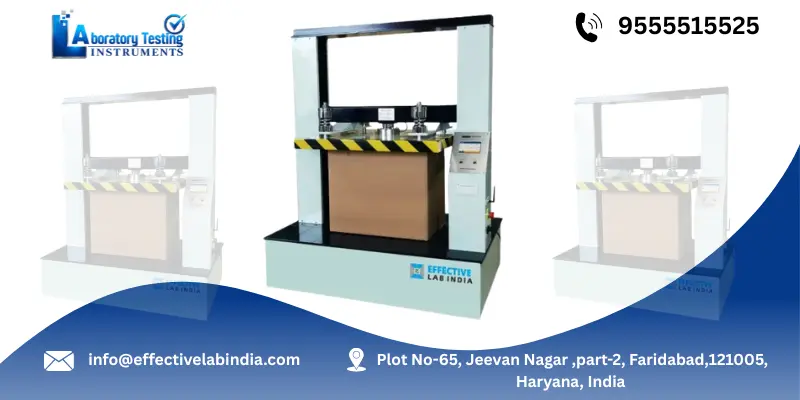
Box Compression Testing is a standardized packaging strength test used to determine the maximum compressive load a corrugated box, carton, or shipping container can withstand before failure. In this test, the sample box is placed between two rigid compression platens, and a controlled force is applied vertically from the top.
As pressure increases, the testing system records the load at which the box begins to deform, buckle, or collapse. This data helps manufacturers assess whether a box is suitable for stacking, warehousing, and transportation conditions.
Box compression testing helps manufacturers:
- Determine how much weight corrugated boxes can support
- Determine stacking strength for storage and transport
- Compare different board grades and packaging designs
- Reduce product damage during shipping
- Optimize packaging without overusing material
- Maintain packaging quality across production batches
In industries where large volumes of products are packed and transported daily, compression testing is essential for both performance and cost control.
The Significance of ASTM and ISO Standards in Box Compression Testing
Testing a corrugated box without following a recognized standard can produce inconsistent and unreliable results. A packaging team may know that a box failed under pressure, but without a standard method, it becomes difficult to compare results across batches, suppliers, locations, or export requirements.
This is where ASTM and ISO standards become critical.
These standards define:
- How the box should be placed during the test
- The speed and method of load application
- Conditioning requirements before testing
- Test environment expectations
- Reporting methods for compression results
- Guidelines for evaluating complete transport packages
By following these standards, manufacturers can ensure that their box compression test results are accurate, repeatable, and technically valid. This is especially important for companies supplying packaging to large brands, exporters, e-commerce businesses, and industries with strict quality control procedures.
ASTM D642 – Standard for Compressive Resistance of Shipping Containers
One of the most commonly used standards for box compression testing is ASTM D642. This test method is used to determine the compressive resistance of shipping containers, components, and unit loads under controlled laboratory conditions.
ASTM D642 is widely used in the packaging industry to evaluate how corrugated boxes, cartons, and transport containers behave when exposed to vertical compressive force. The standard is particularly useful for simulating the stacking loads a box may experience during warehousing or transportation.
ASTM D642 is commonly used for:
- Corrugated box compression strength measurement
- Evaluating shipping container durability
- Checking stacking performance in storage conditions
- Comparing packaging designs and material grades
- Identifying weak packaging structures before dispatch
- Supporting quality assurance in box manufacturing
For corrugated box manufacturers and packaging users, ASTM D642 provides a dependable benchmark for testing whether a box can perform safely under expected handling and stacking conditions.
Compression and Stacking Tests for Filled Transport Packages, ISO 12048
Another highly important standard in packaging quality evaluation is ISO 12048. This standard focuses on the compression and stacking performance of complete, filled transport packages.
While ASTM D642 is often used to evaluate the compressive resistance of shipping containers and packaging structures, ISO 12048 becomes especially useful when the objective is to test the actual transport package in a filled condition. This gives manufacturers a more practical view of how the package will behave during real-world warehousing, stacking, and shipping.
ISO 12048 is used to:
- Test complete filled transport packages
- Evaluate compression resistance under realistic loading conditions
- Measure stacking performance of shipping cartons
- Verify packaging suitability for export and distribution
- Support compliance in international supply chains
- Boost product security when it’s being transported and stored
For exporters, logistics operators, and companies supplying products across multiple locations, ISO-based testing adds confidence that packaging can withstand real shipment conditions.
ASTM D642 vs ISO 12048: What’s the Difference?
Both standards are important for box compression evaluation, but they are used slightly differently depending on the packaging objective.
ASTM D642
- Focuses on compressive resistance of shipping containers and packaging units
- Commonly used for corrugated boxes, cartons, and transport containers
- Useful for understanding structural compression strength of packaging
ISO 12048
- Focuses on compression and stacking tests for complete, filled transport packages
- Useful when testing the actual shipping package under realistic distribution conditions
- Often preferred for international packaging validation and export applications
In many packaging quality programs, both standards can be relevant depending on whether the goal is to test the empty packaging structure or the filled transport package under stacking load.
Factors That Affect Box Compression Strength
The compression strength of a corrugated box is not determined by one factor alone. Multiple variables influence how much load a box can bear before failure. This is why laboratory testing is so important—visual inspection or board thickness alone cannot fully predict real box performance.
Key factors affecting box compression strength include:
1. Corrugated Board Quality
The strength of the paperboard used in the liner and flute layers has a direct impact on compression performance. Better raw material quality usually leads to stronger box performance.
2. Flute Type and Board Construction
Flute profile, wall construction, and the combination of liners and medium affect the structural integrity of the box. Different flute types behave differently under top-load pressure.
3. Box Dimensions and Design
The size of the box, height-to-width ratio, and structural design all influence compression strength. Larger boxes may experience different stress behavior compared to compact cartons.
4. Paper GSM
The GSM of linerboard and fluting paper plays an important role in box strength. Incorrect paper specification can reduce stacking performance significantly.
5. Moisture and Humidity
Corrugated boxes are highly sensitive to moisture. High humidity can weaken the paper structure and reduce the load-bearing capacity of the box. This is one of the biggest reasons why conditioning and standardized testing are necessary.
6. Creasing and Folding Quality
Poor creasing, damaged corners, uneven folding, or improper slotting can reduce the structural performance of a box even when the board grade is technically correct.
7. Storage Conditions
Boxes stored in humid, poorly ventilated, or overloaded warehouse conditions may lose compression strength over time. Long-term stacking also affects packaging durability.
8. Box Closure and Load Distribution
Improper sealing, weak joints, and uneven internal load distribution can create pressure concentration points that reduce overall compression resistance.
Because of these variables, testing every packaging design through a Box Compression Tester becomes essential before mass production or commercial dispatch.
Why Use a Box Compression Tester from Laboratory Testing Instruments?
At Laboratory Testing Instruments, our Box Compression Tester is designed to help manufacturers and testing labs evaluate the compression strength of corrugated boxes, paperboard cartons, and transport packaging with a high level of precision.
The machine is suitable for quality control, packaging development, supplier validation, and product performance testing. It helps users assess whether a packaging design can withstand stacking loads and transport pressure before it is used in the real market.
Benefits of using our Box Compression Tester:
- Accurate measurement of box compression strength
- Reliable testing for corrugated boxes and cartons
- Useful for stacking load and transport packaging analysis
- Supports packaging quality control and R&D
- Helps reduce shipping damage and customer complaints
- Assists in material optimization and cost control
- Suitable for manufacturers, labs, and exporters
With a dependable compression testing system, packaging teams can make informed decisions about box design, paper grade, stacking limits, and transport suitability.
Conclusion
ASTM and ISO standards play a major role in making box compression testing meaningful and reliable. ASTM D642 helps evaluate the compressive resistance of shipping containers and corrugated boxes, while ISO 12048 is especially useful for testing complete filled transport packages under compression and stacking conditions.
Together, these standards help manufacturers, packaging professionals, and quality control teams validate packaging strength with confidence. By performing box compression tests according to recognized international standards, businesses can improve packaging quality, reduce product damage, optimize material usage, and maintain consistency across supply chains.
If you are looking for a reliable solution to test the compression strength of corrugated boxes, cartons, and transport packaging, Laboratory Testing Instruments offers advanced Box Compression Tester solutions designed to support modern packaging quality requirements.
For more information about Box Compression Testers and other packaging testing equipment, contact Laboratory Testing Instruments today.
Contact Us
For more information about Box Compression Tester and other laboratory testing instruments, feel free to get in touch with us.
Effective Lab India
Phone: +91 9555515525
Email: info@effectivelabindia.com
Address: Plot No-65, Jeevan Nagar, Part-2, Faridabad, 121005, Haryana, India