
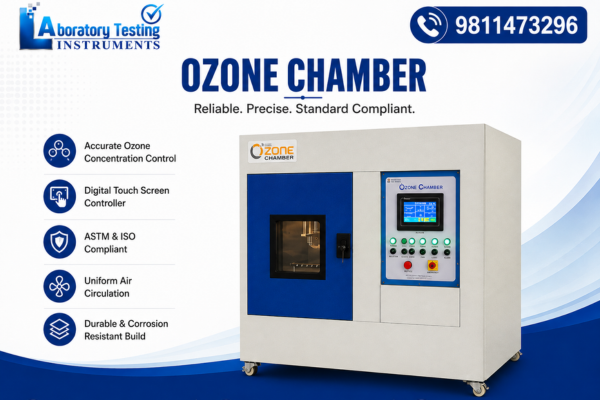
Ozone Resistance Testing is an essential laboratory procedure used to evaluate the durability and performance of rubber materials exposed to ozone-rich environments. Rubber products are continuously exposed to sunlight, air pollution, moisture, temperature fluctuations, and ozone. Among these environmental factors, ozone is one of the most harmful because it can cause tiny surface cracks that gradually weaken rubber materials. Even a low concentration of ozone in the atmosphere can significantly reduce the lifespan of rubber components if they are not properly tested before use.
This is where Rubber Ozone Testing becomes essential. Manufacturers rely on advanced laboratory testing equipment to evaluate how rubber compounds perform under controlled ozone exposure. By conducting Ozone Resistance Testing, industries can identify material weaknesses, improve product durability, and ensure compliance with international quality standards before products reach customers.
An Ozone Aging Test Chamber creates a controlled testing environment that simulates ozone-rich conditions, allowing engineers to perform accelerated aging tests within a short period. These tests help manufacturers develop high-quality rubber products that can withstand harsh environmental conditions while maintaining flexibility, strength, and performance.
In this complete guide, we will explain everything you need to know about Rubber Ozone Testing, including its importance, testing methods, working principles, industrial applications, testing standards, and how to select the right equipment for your laboratory.
What Is Rubber Ozone Testing?
Rubber Ozone Testing is a laboratory testing process used to determine how resistant rubber materials are to ozone exposure. During the test, rubber samples are placed inside an ozone-controlled chamber where they are exposed to a predefined ozone concentration, temperature, and testing duration.
The purpose of this test is to observe whether the material develops surface cracks, loses elasticity, or experiences physical degradation after prolonged exposure to ozone.
Since natural weather exposure may take several months or even years, laboratory-based ozone testing accelerates the aging process while maintaining accurate and repeatable testing conditions. This allows manufacturers to evaluate product performance much faster and make improvements before commercial production.
Today, Rubber Ozone Testing has become a standard quality control procedure across industries that manufacture rubber-based products.
Why Is Ozone Resistance Testing Important?
Ozone is a highly reactive gas that attacks unsaturated rubber molecules, leading to microscopic cracks on the surface. These cracks gradually expand under mechanical stress and eventually cause material failure.
Proper Ozone Resistance Testing helps manufacturers detect these problems before products enter the market.
Some key benefits include:
- Improves product durability
- Reduces premature material failure
- Increases customer confidence
- Supports product research and development
- Ensures compliance with international testing standards
- Minimizes warranty claims
- Enhances overall product quality
- Improves long-term outdoor performance
By conducting regular ozone resistance tests, manufacturers can produce more reliable rubber products capable of performing under challenging environmental conditions.
How Does An Ozone Aging Test Chamber Work?
An Ozone Aging Test Chamber is designed to reproduce ozone-rich environmental conditions inside a controlled laboratory environment. Instead of waiting for years to observe natural weathering, manufacturers can evaluate ozone resistance within a few days or weeks.
The testing process begins by placing prepared rubber specimens inside the chamber. An ozone generator produces a stable ozone concentration while the digital control system continuously regulates environmental conditions.
During testing, the chamber carefully controls:
- Ozone concentration
- Temperature
- Exposure duration
- Air circulation
- Relative humidity (when required)
Depending on the selected testing standard, rubber specimens may remain under static or stretched conditions throughout the testing cycle. After exposure is complete, engineers inspect each specimen for visible cracking, discoloration, hardening, or changes in flexibility.
This accelerated testing method provides highly reliable information about the expected service life of rubber products.
Major Components Of An Ozone Aging Test Chamber
A high-quality Ozone Aging Test Chamber consists of several precision-engineered components that ensure accurate and repeatable testing results.
Ozone Generation System
The ozone generator produces a stable and precisely controlled ozone concentration for testing rubber specimens under standardized conditions.
Stainless Steel Testing Chamber
The chamber is manufactured using corrosion-resistant stainless steel to ensure durability and resistance against ozone exposure.
Digital Temperature Controller
An intelligent control system maintains accurate testing temperatures throughout the entire testing process.
Air Circulation System
Uniform air circulation distributes ozone evenly across all test samples, ensuring consistent exposure.
Sample Holding Fixture
Special fixtures securely hold rubber specimens in either static or dynamic strain conditions according to testing standards.
Safety Protection System
Advanced safety mechanisms prevent ozone leakage while ensuring operator safety during testing.
Applications Of Rubber Ozone Testing
Modern industries depend on Rubber Ozone Testing to improve product reliability and maintain quality standards.
Common applications include:
- Automotive rubber components
- Industrial rubber products
- Rubber hoses
- O-rings
- Gaskets
- Cable insulation
- Conveyor belts
- Rubber sheets
- Medical rubber products
- Sealing materials
- Construction rubber components
- Aerospace rubber parts
Testing these products before commercial use significantly improves their service life and reduces the possibility of field failures.
Industries That Require Ozone Resistance Testing
Automotive Industry
Vehicle manufacturers test weather strips, seals, engine mounts, hoses, suspension components, and rubber gaskets to ensure long-term durability.
Rubber Manufacturing Industry
Rubber compound manufacturers use ozone testing during research, product development, and production quality control.
Electrical Industry
Cable manufacturers evaluate insulation materials for outdoor applications where ozone exposure is common.
Construction Industry
Expansion joints, waterproof membranes, and sealing systems undergo ozone testing to verify long-term weather resistance.
Aerospace Industry
Aircraft manufacturers perform ozone resistance tests on safety-critical rubber components used in demanding environmental conditions.
Research Laboratories
Universities, government laboratories, and industrial R&D centers use ozone chambers to develop advanced rubber materials with improved environmental resistance.
Benefits Of Rubber Ozone Testing
Investing in professional Ozone Resistance Testing offers several long-term advantages.
- Detects surface cracking before product launch
- Improves rubber quality
- Reduces product failure
- Supports faster product development
- Increases customer satisfaction
- Enhances quality control
- Meets international testing requirements
- Improves product reliability
- Reduces maintenance costs
- Supports continuous innovation
ASTM D1149 Standard For Rubber Ozone Testing
One of the most widely recognized standards for Ozone Resistance Testing is ASTM D1149. This international standard specifies the procedures for evaluating the ozone resistance of vulcanized rubber under controlled laboratory conditions.
The standard defines important testing parameters such as:
- Ozone concentration
- Temperature
- Exposure duration
- Sample preparation
- Specimen mounting
- Evaluation of surface cracks
Following ASTM D1149 helps laboratories produce consistent, accurate, and repeatable results while ensuring products meet international quality requirements.
Step-By-Step Rubber Ozone Testing Procedure
A standard Rubber Ozone Testing process follows several carefully controlled steps.
1. Sample Preparation
Rubber specimens are prepared according to the required dimensions specified by the testing standard.
2. Mounting The Specimen
The samples are mounted on fixtures in either static or stretched conditions depending on the test requirement.
3. Chamber Configuration
The operator sets:
- Ozone concentration
- Chamber temperature
- Exposure duration
- Air circulation
- Humidity (if applicable)
4. Testing Cycle
The specimens remain inside the Ozone Aging Test Chamber for the required testing period while environmental conditions remain stable.
5. Inspection
After testing, engineers carefully inspect the samples for:
- Surface cracks
- Elasticity changes
- Material degradation
- Color changes
- Structural damage
The observations help determine whether the material meets the required quality standards.
Factors Affecting Ozone Resistance Testing
Several factors influence the accuracy of Ozone Resistance Testing.
Ozone Concentration
Higher ozone concentrations accelerate material degradation and reduce testing time.
Temperature
Temperature directly affects the oxidation rate and aging behavior of rubber materials.
Exposure Duration
Longer exposure periods produce more realistic long-term durability results.
Material Composition
Different rubber compounds respond differently to ozone exposure.
Mechanical Stress
Rubber under tension generally develops ozone cracks faster than unstressed samples.
Air Circulation
Uniform airflow ensures every specimen receives equal ozone exposure.
Maintaining these parameters accurately is essential for obtaining reliable laboratory results.
How To Choose The Right Ozone Aging Test Chamber
Selecting the correct Ozone Aging Test Chamber depends on your testing requirements and industry standards.
Consider the following factors before purchasing:
- Chamber capacity
- Ozone concentration range
- Temperature control accuracy
- Digital programmable controller
- Stainless steel construction
- Air circulation efficiency
- Compliance with ASTM D1149
- Easy maintenance
- User-friendly interface
- Reliable after-sales support
Choosing a high-quality testing chamber improves laboratory efficiency and ensures consistent test results for years to come.
Common Mistakes During Rubber Ozone Testing
Incorrect testing procedures can affect the accuracy of results.
Some common mistakes include:
- Improper specimen preparation
- Incorrect ozone concentration
- Uneven air circulation
- Poor temperature control
- Inadequate chamber calibration
- Incorrect specimen mounting
- Ignoring ASTM testing standards
- Poor maintenance practices
Avoiding these issues helps laboratories maintain reliable and repeatable testing performance.
Maintenance Tips For An Ozone Aging Test Chamber
Routine maintenance extends equipment life and ensures consistent testing performance.
Recommended maintenance practices include:
- Clean the chamber after testing.
- Inspect the ozone generator regularly.
- Calibrate sensors periodically.
- Verify ozone concentration accuracy.
- Check air circulation fans.
- Inspect electrical connections.
- Replace worn seals when necessary.
- Schedule preventive maintenance.
Regular servicing minimizes downtime and improves long-term reliability.
Why Choose Laboratory Testing Instruments?
At Laboratory Testing Instruments, we manufacture advanced testing equipment designed to deliver accurate, reliable, and repeatable results for quality control laboratories across multiple industries.
Our testing solutions are widely used in:
- Rubber Industry
- Plastic Industry
- Packaging Industry
- Automotive Industry
- Electrical Industry
- Paint & Coating Industry
- Research Laboratories
- Educational Institutions
Our equipment offers:
- Precision Engineering
- Digital Automation
- High Accuracy
- Durable Construction
- User-Friendly Operation
- Compliance With International Standards
- Excellent Technical Support
- Long Service Life
Whether you require an Ozone Aging Test Chamber or other laboratory testing equipment, our experienced team can help you choose the right solution for your application.
Frequently Asked Questions
What Is Ozone Resistance Testing?
Ozone Resistance Testing is a laboratory testing process used to evaluate how rubber, elastomers, and polymer materials perform when exposed to controlled ozone conditions. The test helps identify surface cracking, loss of elasticity, and material degradation caused by ozone exposure. By using an Ozone Test Chamber, manufacturers can simulate long-term environmental conditions in a shorter time, ensuring that rubber products meet quality standards, improve durability, and deliver reliable performance in real-world applications.
What Is Rubber Ozone Testing?
Rubber Ozone Testing evaluates how rubber materials resist ozone-induced cracking and degradation under controlled laboratory conditions.
What Is An Ozone Aging Test Chamber Used For?
It is used to simulate ozone exposure and assess the durability of rubber, elastomers, seals, gaskets, hoses, and similar materials.
Which Industries Use Ozone Resistance Testing?
Automotive, rubber manufacturing, electrical, aerospace, construction, research laboratories, and quality control facilities commonly perform ozone resistance testing.
Which Standard Is Used For Ozone Testing?
ASTM D1149 is one of the most commonly followed international standards for rubber ozone resistance testing.
Why Is Ozone Resistance Testing Important?
It helps manufacturers identify potential material failures, improve product quality, and ensure long-term durability before products are released to the market.
How Long Does Rubber Ozone Testing Take?
The testing duration depends on the selected standard, ozone concentration, and product requirements. Most tests are completed within a few hours to several days.
Can Different Rubber Materials Be Tested?
Yes. Natural rubber, synthetic rubber, elastomers, seals, hoses, gaskets, and many polymer-based materials can be evaluated.
What Are The Benefits Of An Ozone Aging Test Chamber?
It provides accelerated aging, reliable quality control, repeatable results, faster product development, and compliance with international testing standards.
Conclusion
As industries continue to demand more durable and reliable rubber products, Rubber Ozone Testing has become an essential part of modern quality assurance. By performing accurate Ozone Resistance Testing using a high-performance Ozone Aging Test Chamber, manufacturers can identify material weaknesses early, improve product performance, reduce warranty claims, and comply with internationally accepted standards such as ASTM D1149.
Investing in advanced ozone testing equipment not only improves product quality but also supports innovation, customer satisfaction, and long-term business success.
Get Expert Laboratory Testing Solutions
Looking for reliable laboratory testing equipment for your quality control or research laboratory? Laboratory Testing Instruments offers precision-engineered solutions designed to meet international testing standards across multiple industries. Our experts can help you select the right equipment for your specific testing requirements.
Contact Laboratory Testing Instruments
Address
Laboratory Testing Instruments
Plot No-65, Jeevan Nagar, Part-2, Faridabad – 121005, Haryana, India