Industrial BOD Incubator has emerged as one of the most essential instruments for applications in environmental tests, water analysis, pharmaceuticals, and food sciences labs. If you are an engineer responsible for quality control, an environmental scientist, or a manager looking for the best possible manufacturer for the procurement of this instrument, then you should know about the BOD incubator diagram, specifications, and selection criteria for a trusted manufacturer.
Here at Effective Lab India, we manufacture and supply precision testing instruments like BOD Incubator, Salt Spray Chamber, Ozone Test Chamber, Paper Testing Instruments, Rubber Testing Instruments, and Environmental Testing equipments. This article/blog post will serve as a detailed guide on all things about the BOD incubator.
Humidity Chamber Manufacturer

What is a BOD Incubator? Principle, Working & Core Applications
A BOD Incubator (Biochemical Oxygen Demand Incubator) is a chamber that provides temperature control to provide an environment that remains constant — normally at 20°C ± 0.5°C — during the incubation process of biological and microbiological samples for a specific time period, usually five days (BOD5 test). The BOD5 test is a universally recognized standard procedure for assessing the organic pollution content in water samples.
Principle of Operation
The underlying principle behind the operation of a BOD Incubator involves the use of either thermoelectric cooling or compression cooling, together with heating systems. The internal temperature inside the chamber is regulated by using a PID (Proportional-Integral-Derivative) controller microprocessor to achieve uniform temperature throughout the chamber.
Core Applications:
- Analysis of wastewater and effluent in industrial and municipal settings
- Conducting stability studies in pharmaceuticals and growth studies in microbial cultures
- Testing food products and beverages in microbial analysis
- Supporting environmental studies and experiments in academic laboratories
- Monitoring water quality in aquaculture and fishing
- Conducting biological studies in soil and compost
The BOD Incubator is not a luxury but a requirement in many nations. The Environmental Protection Agency, pollution control board, and several international organizations like ISO, APHA, and BIS have made it mandatory to conduct BOD analysis.
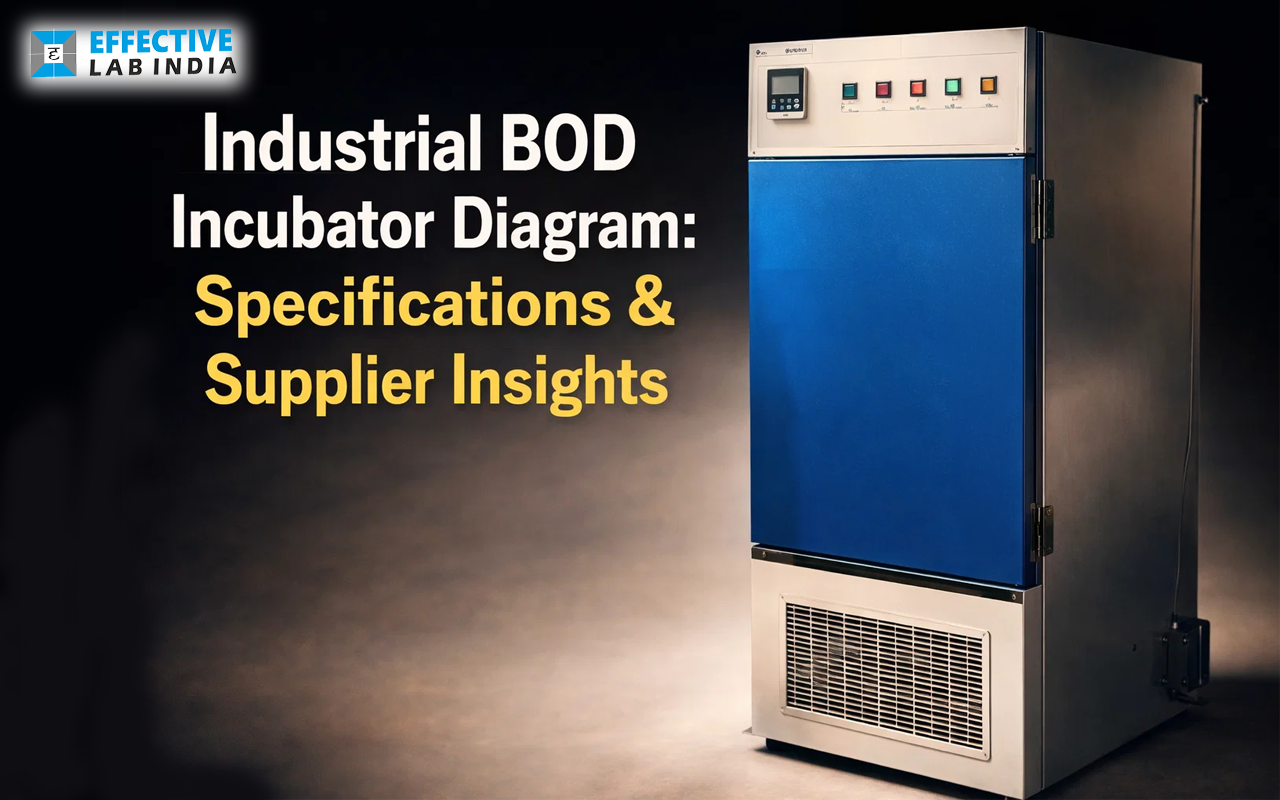
BOD Incubator Diagram with Labels: Components and Functional Layout
Understanding how each component affects the performance of the entire BOD incubator can be achieved through a properly labeled diagram of the BOD incubator. This section will provide a comprehensive description of the components seen on an industrial BOD incubator diagram.
| Component | Function in BOD Incubator |
| Double-Walled Chamber | Insulates the cabinet, minimising heat exchange with the surrounding environment |
| Compression Refrigerant System | Raises the temperature inside the cabinet to the preset value of 20°C |
| Internal Heating Mechanism | Sensors of high accuracy are distributed within the cabinet to ensure temperature uniformity map |
| PID Temperature Controller | Microprocessor controller responsible for the precise regulation of heating/cooling, ±0.5°C accurate |
| Pt100 Resistance Temperature Detector (RTD) | An insulation layer that also provides cabinet integrity |
| Glass Inner Door | Drives the refrigeration process, lowering the temperature inside the cabinet to 5°C |
| External Door | Sensors of high accuracy are distributed within the cabinet to ensure a temperature uniformity map |
| Lighting System | Presents the current temperature, preset temperature, and alarm status |
| Wire Shelves | Position-adjustable shelves to accommodate different-sized BOD bottles |
| Digital Display | Sensors of high accuracy are distributed within the cabinet to ensure a temperature uniformity map |
| Alarming System | Alarming System Audio/video alerts for the temperature deviation from the preset values |
| Water Drain Outlet | Drainage for decontamination purposes |
The BOD incubator schematic is very important when making comparisons between various brands and models. Consumers should always insist on getting a schematic from the supplier, detailing how the airflow works within the cabinet, where the sensors are located, and how the refrigeration system works.
Temperature Uniformity and Mapping
There is one feature of the BOD incubator diagram that most consumers do not pay attention to – the air flow pattern. In industrial-level BOD incubators, forced air circulation is achieved by using fans. The high-quality devices manufactured by Effective Lab India have a special validation test of nine-point temperature mapping. It guarantees that all corners will have a temperature difference of no more than ±0.5°C.
Industrial BOD Incubator Specifications & How to Choose the Right Supplier
While selecting a BOD Incubator for any industrial or institutional use, specifications exceed the temperature range by a significant margin. Here is a list of technical specifications that must be taken into consideration:
| Specification Parameter | Recommended Range / Value |
| Temperature Range | 5°C to 60°C (also, some models have 0°C to 70°C range) |
| Accuracy of Temperature Control | ±0.5°C at 20°C |
| Uniformity of Temperature | ±1°C within the Chamber |
| Capacity | 50 liters to 700 liters (sizes other than stated can be custom made) |
| Type of Controller | Microprocessor-based PID Controller with Digital Display |
| Sensor | PT100 Platinum RTD |
| Refrigerant Used | CFC-free, eco-friendly refrigerants (R134a or similar) |
| Power Requirement | 220V / 50Hz (single Phase) |
| Chamber Internal Finish | Surgical Grade Stainless Steel (SS 304/SS 316) |
| Chamber External Finish | Mild Steel with Powder Coated Finish / SS Exterior |
| Chamber Door | Multilayer Double Door (Inner glass/outer solid door with Magnetic Gasket) |
| Interior Shelves | Stainless Steel Perforated/Wire Shelves |
| Safety Features | Over-Temperature Alarm, Low Temperature Alarm, Door Open Alarm |
| Compliant to Standards | ISO 17025, APHA Standard Methods, BIS standards |
| Logging of Data | RS-232/USB/Optional RS-485 |
How to Choose the Right BOD Incubator Supplier
Supplier selection is equally as important as specification selection. The following are some of the key criteria you must look into:
- Experience in Manufacturing: Suppliers that have been producing environmental testing machines for 5-10 years are a good choice. Effective Lab India can boast about many years of combined experience in manufacturing testing devices.
- ISO 9001:2015 Certification: Make sure that the equipment manufacturer is certified under the ISO 9001:2015 quality management system, and that all products meet necessary national and international standards.
• After-Sales Service: An efficient supplier will provide you with immediate calibration services, AMC agreements, and timely spare parts. Check whether this particular company has its after-sales service available in your area. - NABL Calibrated Equipment: Every supplied device must come with a calibrated certificate traceable to NABL.
- Customization Potential: The need for industrial users could be customization of the capacity, material used inside the unit, or any other feature. Effective Lab India has the capacity to customize the BOD Incubator according to your requirements.
- Testimonials and Installation Case Studies: Ask for references from clients within the same industry. The supplier who provides such references and test cases indicates their reliability.
- Minimum Warranty: There should be at least a one-year warranty for parts and labor, while other terms, such as extended warranty, AMC, etc., indicate the reliability of the supplier.
Effective Lab India is a well-known company in India as far as testing equipment goes. It manufactures salt spray chambers for corrosion testing, ozone test chambers for rubber and polymer degradation testing, paper testing instruments for the packaging industry, rubber testing instruments for tires and rubber quality checks, and a variety of environmental testing equipment.
Suggested Post:
Salt Spray Corrosion test Chamber Manufacturer in India
Edge Crush Test Calculator: How to Use for Packaging Strength
TCO Point of View
Many purchasing choices may solely be influenced by the cost of purchase; however, this might prove to be very expensive. The total cost of owning a BOD incubator will include the price of acquisition, the price for setup, annual energy use, calibration & maintenance costs, spare parts, and downtime due to system malfunction. An excellent-quality BOD incubator from a reputable Indian manufacturer ensures that there is a much lower total cost of ownership than other low-cost products that break down easily and do not maintain proper temperature consistency — hence invalid results and repeat test costs.
Conclusion
The BOD Incubator goes beyond a mere temperature-controlled chamber since it plays an essential role in ensuring the accuracy of environmental and water tests. Knowledge of the BOD Incubator diagram, features, operation principles, and industrial specifications helps laboratory managers make well-informed decisions that will guarantee regulatory compliance and accuracy. Effective Lab India proves to be an excellent manufacturing partner for high-performing BOD Incubators and testing equipment designed to meet strict laboratory and industrial standards. To learn more about our products through a brochure, customized specification, and quotations, contact Effective Lab India today!
Frequently Asked Questions (FAQs)
Why do we have a standard temperature for the BOD incubator?
The universally accepted temperature for determining biological oxygen demand is 20°C ± 0.5°C. The reason behind this is that this temperature is recommended by international organizations such as APHA, ISO, and BIS. They recommend this temperature because of the fact that water bodies in temperate climates have an approximate average temperature of 20°C. The bacterial activity for breaking down the organic matter in water is constant and predictable at 20°C.
Why is the BOD incubator different from a normal laboratory oven or incubator?
There are a few differences between the BOD incubator and a normal laboratory oven. First of all, a BOD incubator has both heating and cooling systems as compared to normal laboratory ovens. The main reason for having a cooling system in a BOD incubator is the requirement of maintaining the temperature below the room temperature. It is required because 20°C is often below room temperature in tropical countries such as India. Moreover, another difference is that BOD incubators provide uniformity in temperature across their chamber.
Which capacity of the BOD Incubator do I need for industrial application?
This depends upon the number of samples and the quantity that you test on a day-to-day basis in your laboratory. For a small research lab or for quality assurance testing, 50-liters to 150-liter capacity of the BOD Incubator would suffice. If you are an effluent treatment plant and perform multiple tests in parallel, then you should consider using a 200-liter to 400-liter BOD Incubator. 500 liters to 700 liters or above is recommended for industrial laboratories or municipalities having many testing parameters.
How frequently should a BOD Incubator be calibrated?
For ISO/IEC 17025/NABL-accredited labs, the minimum requirement is annual calibration of the BOD Incubator with NABL traceable standard values. For high-throughput industries and in cases where results are being reported for regulatory compliance purposes, the suggested calibration frequency would be every six months. Also, as per the requirement, a performance verification exercise needs to be conducted on completion of repairs, relocation of the instrument, or even in case of changes to the laboratory environment (air conditioning, for instance).
Why should I select Effective Lab India for my BOD Incubator requirements?
Effective Lab India is an Indian company that has been in the manufacturing business for years. They have experience in many different products such as BOD Incubators, Salt Spray Chamber, Ozone Test Chamber, Paper Testing Machines, Rubber Testing Machines, and Environmental Testing Machinery. Their BOD incubators come with high-quality interior materials made of stainless steel, non-CFC refrigeration, PID microprocessor controls, and are manufactured to meet ISO, BIS, and APHA norms. In addition, they provide NABL-certified calibration certificates, after-sales services, annual maintenance contracts, and modifications according to project needs.