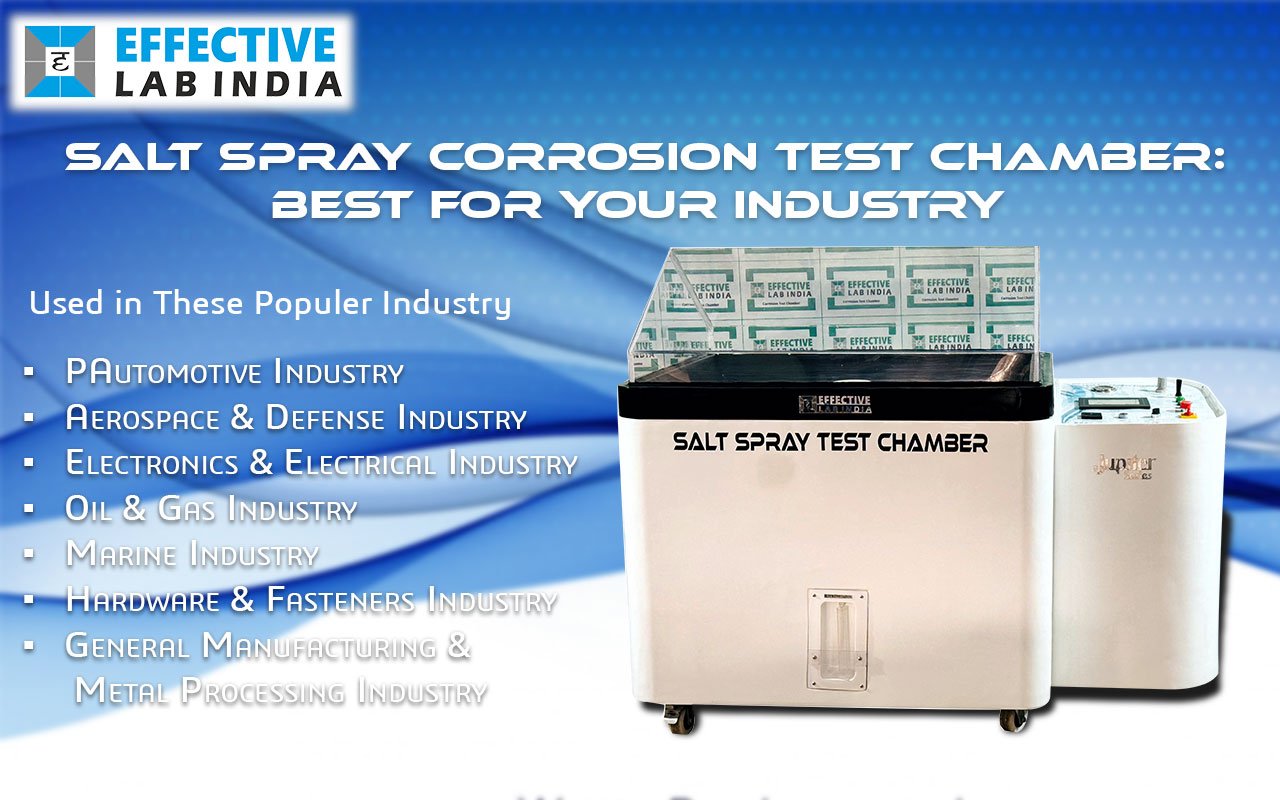
Salt Spray Test Chamber Manufacturer in India: The salt spray test is the gold standard for industrial product corrosion protection. Effective Lab India is a reputed manufacturer of salt spray test chambers, providing precision testing instrumentation complying with the best available international standards. From automotive, aerospace, electronics, or coatings — our salt spray test chambers are designed to deliver accurate, repeatable, and reliable corrosion test results every time.
What Is A Salt Spray Chamber And Why Does Every Modern Manufacturer Need One?
A salt spray chamber — which may also be referred to as either a salt fog test chamber or a salt spray corrosion test chamber — is one variety of laboratory testing device, used to simulate the corrosive effects of an atmospheric environment laden with high saline water saturation on material. By placing test specimens in a controlled saline fog environment, manufacturers are able to predict how coatings, metals, and finishes will hold up to stresses in the real-world before they ever get to market.
A salt spray test is not optional in modern manufacturing — it’s a compliance requirement. Manufacturers across a wide spectrum of industries, from automotive parts and military hardware to marine equipment and consumer electronics, are required to demonstrate corrosion resistance via standardized salt spray testing protocols. Without a quality salt spray test chamber, manufacturers can experience failures, expensive product recalls, and harm to their reputation.
Here are some of the key reasons why manufacturers rely on a salt spray chamber:
- Detection of coating defects and material weakness from early stages
- ASTM B117, ISO 9227, JIS Z 2371, and compliance with other international standards
- Minimized expensive field failures and warranty claims
- Shorter time-to-market with proven corrosion-resistant products
- Confidence in the Quality of Products throughout Supply Chains
- Corrosion conditions as they appear in the real world.
Salt spray test chamber: Manufacturers must appreciate its importance by understanding the science behind it. Within the chamber, an exactly formulated sodium chloride (NaCl) solution — usually ranging from 5% concentration — is atomised into a fine mist with the aid of a compressed air nozzle system that produces constant fog. It is temperature-controlled (typically 35°C ± 2°C for neutral salt spray (NSS) tests) to ensure that the environment is consistent and reproducibly exact from one test cycle to the next.
Salt Spray Corrosion Test Chamber’s Advanced Features
To ensure that the saline fog evenly settles on the surfaces of the specimens, they are mounted in a salt spray chamber at a prescribed angle. Over time — anywhere from 24 hours to more than 1,000 hours based on its use — the chamber demonstrates the rate of corrosion, rust, blistering, or delamination on the test surface.
Our salt spray test chambers at Effective Lab India have advanced features to ensure a consistent fog dispersion, uniform temperature, and pH control. Our chambers feature high-grade PVC construction, premium fiberglass assemblies, and corrosion-resistant components — which means long service life even with continuous operation. For minimal intervention, digital controllers with programmable cycles allow for ASTM B117 (Salt Spray Test), (Copper-Accelerated Acetic Acid Salt Spray) CASS Cum Salt Spray Test, and MASS (Modified Acid Salt Spray) testing capabilities.
Salt Spray vs Cyclic Corrosion — Which Assessment for Your Product?
Salt Spray Test vs Cyclic Corrosion Testing: One of the most common questions we get as a salt spray test chamber manufacturer is: When should I use a salt spray test or try a cyclic corrosion test? The answer depends on what product you have, what the industry requires, and which real-world environment your product will encounter.
Salt Spray Test (NSS / ASTM B117)
In a traditional salt spray test, products are exposed to an endlessly sustained salt fog environment. It is perfect for comparative analysis of coatings, plating quality, and surface finish. It is universally specified by the automotive OEM, MIL-STD, and industrial coatings qualification. The salt spray test is simple to perform and provides globally accepted results.
Cyclic Corrosion Test (CCT)
Cyclic corrosion tests treat products with alternating phases of salt fog, drying, and humidity to more closely mimic the real-world wet-dry cycles products experience outdoors. Utilised for chassis parts, underbody components, and assemblies exposed to road salts and weather variability, CCT is increasingly being favoured by automotive manufacturers and OEMS. This will yield a result that usually correlates better with true field corrosion response.
Effective Lab India provides the standard salt spray chamber and cyclic corrosion test chambers. Our technical team can partner with you to identify the proper equipment for your industry specifications, the products you design and test, so that you are investing in the correct solution from day one.
Salt Spray Test Chamber Manufacturer Certifications and Quality Standards
That is why when you choose a salt spray test chamber manufacturer, you want to choose one that makes quality and compliance its priority. Salt Spray Chambers at Effective lab India are perfectly designed by analysing the most recognised International testing standards and manufacturing process to follow.
- ASTM B117: The most common salt spray (fog) test standard in North America and worldwide.
- ISO 9227: Corrosion tests in artificial atmospheres — Salt spray tests (NSS, AASS and CASS)
- JIS Z 2371: Japanese Industrial Standard addressing salt fog testing, often requested by Japan-based automotive suppliers.
- IEC 60068-2-11 – Atmospheric Pressure 205: Used for environmental testing of electrical and electronic components.
- IS 9844 (BIS): Bureau of Indian Standards specification for equipment for salt fog testing – Specification- (Second Revision)[02] IS 11986 (BIS): Cyclic corrosion testing of metallic materials – A method[03] ISO standard[04].
- Effective Lab India is an ISO 9001:2015 certified Manufacturer of quality First salt spray test chambers.
We have the highest standards of in-house calibration and performance validation prior to shipment on our chambers, and we also provide end-to-end documentation support that helps clients achieve their own laboratory accreditation under NABL as well as other frameworks.
Why is Effective Lab India a Salt Spray Test Chamber Manufacturer?
For effective manufacturing of the salt spray test chambers, it demands high precision workmanship, so Effective Lab India has gained experimental experience over the years to be one of the most trusted & technically sound salt spray test chamber manufacturers in India. Our chambers represent sectors such as automotive, aerospace, defence, pharmaceuticals, construction, and consumer goods in India и abroad.
- Chamber sizes range from 27 litres to well over 1,000 litres in capacity
- Touch HMI for PLC-based digital control panel
- Saline solution level automatic control and fog nozzle self-cleaning
- Validation of Fog Distribution Uniformity throughout the Full Chamber Volume
- Installation, commissioning, and operator training on-site
- Robust pan-India presence for after-sales service with prompt availability of spare parts
- Values without compromising on quality or compliance
Every ASC salt spray chamber built goes through a thorough quality control process — from materials inspection and assembly, to final factory acceptance testing. We are committed to every creative unit we dispatch.
Frequently Asked Questions (FAQs)
Q1. What is a salt spray test, and what does it measure?
Salt spray test is a laboratory test method used to simulate and accelerate the corrosive environment on your material, coating, or surface finish when it is applied in a saline (salt) fog environment. The test is performed in a salt spray test chamber, where a 5% sodium chloride solution is atomised into an uninterrupted fine mist at a controlled temperature (usually at 35 degrees Celsius). Results assist manufacturers in the benchmarking of corrosion resistance across disparate coatings or materials, confirming compliance with international standards like ASTM B117 and ISO 9227, and forecasting product longevity in hostile environments.
Q2. How long does it take to make a salt spray test chamber, and what is the process?
The salt-spray test chamber is usually a high-grade rigid PVC or fibreglass-reinforced plastic and capable of withstanding the saline fog always produced during testing. The internal components (nozzles, reservoirs, and specimen supports) are made of corrosion-resistant materials such as PVC, PVDF, or polypropylene. An accredited and trusted manufacturer like Effective Lab India can provide a salt spray chamber that shows reliable performance, if maintained properly for 10 to 15 years or longer. Routine upkeep — like cleaning fog nozzles, checking pH levels, and inspecting seals — greatly prolongs chamber longevity.
Q3. How important is a salt spray chamber in product testing for some industries?
The salt spray chamber is widely applied in a variety of industries. Car makers evaluate body panels, fasteners, brake components, and electrical connectors. Aerospace manufacturers assess structural solutions, coatings, and surface treatments on airline parts. PCBs, connectors, and hardware must always be evaluated against corrosion resistance by electronics manufacturers. Steel structures, galvanised sheets, and architectural hardware are tested by construction product makers. Salt spray testing is used in the marine and defence sectors to simulate long-term exposure of components to saltwater conditions. Salt spray chambers are also used by consumer goods companies to validate the durability of appliances, plumbing fittings, and decorative finishes.
Q4. What size salt spray test chamber do I need for my laboratory?
Choosing the proper salt spray chamber size is a decision dictated mostly by your test sample dimensions and the quantity of simultaneously evaluated specimens. Smaller chambers (27 to 100 litres) are appropriate for testing of small components, fasteners, and coupons. Medium size (200 to 400 litres) for similar automotive parts, brackets, and assemblies. Larger chambers (600 litres and above) are used for full-scale panels, structural components, and batch testing with multiple specimens. Effective Lab India manufactures chambers for the complete capacity range, and our technical team will be able to evaluate your specific specimen size and throughput needs, then recommend the best salt spray test chamber for your operations.
Q5. Standards that a salt spray test chamber manufacturer must adhere to.
A good salt spray test chamber manufacturer only develops equipment that is compatible with the following relevant global corrosion testing standards, which include, but are not limited to, ASTM B117 (USA), ISO 9227 (international), JIS Z 2371 (Japan), DIN 50021 (Germany), and IS 9844 (India/BIS). The manufacturer must have its own quality management system, certified to ISO 9001:2015, with demonstrated consistency of design, manufacturing processes, and testing. Effective Lab India salt spray chambers are validated against these standards, and we provide complete calibration certificates and traceability documentation as per the laboratory accreditation needs of our customers.
Q6. What is the difference between a salt spray test and a humidity test?
Both tests assess material durability in aggressive atmospheric conditions, but they achieve different ends. One type of chamber is a salt spray test chamber, which exposes specimens to a continuous saline fog specifically in order to measure corrosion resistance, and is the standard method for evaluating coatings, plating, and metallic surfaces. A humidity test, in contrast, exposes materials to high relative humidity — generally 85% to 98% RH — and assesses moisture absorption, swelling, delamination, and mould resistance. Both need to be tested with some products to validate environmental durability comprehensively. Effective Lab India designs and manufactures salt spray test chambers as well as humidity test chambers, which provide a complete solution to corrosion and environmental testing.
Q7. Salt spray chamber for special testing requirements. Can Effective Lab India offer bespoke?
Yes. Effective Lab India as a salt spray test chamber supplier is an experienced manufacturer providing in-house design and engineering for associated customisation of chambers specific to specimen dimensions, proprietary test protocols and compliance standards. Our experience in providing custom salt spray chambers includes defence testing laboratories, automotive OEM quality centres, and third-party accredited testing facilities throughout India. Some custom options are non-standard chamber volumes, integrated cyclic corrosion (CCT), multiple zone temperature control, automatic data logging, and remote monitoring. Talk to our technical team to know your needs.
Get in touch with Effective Lab India for their full suite of test labs catered to your sector.
Contact: (+91) 9555515525
Email: info@effectivelabindia.com
WhatsApp: Effective Lab India