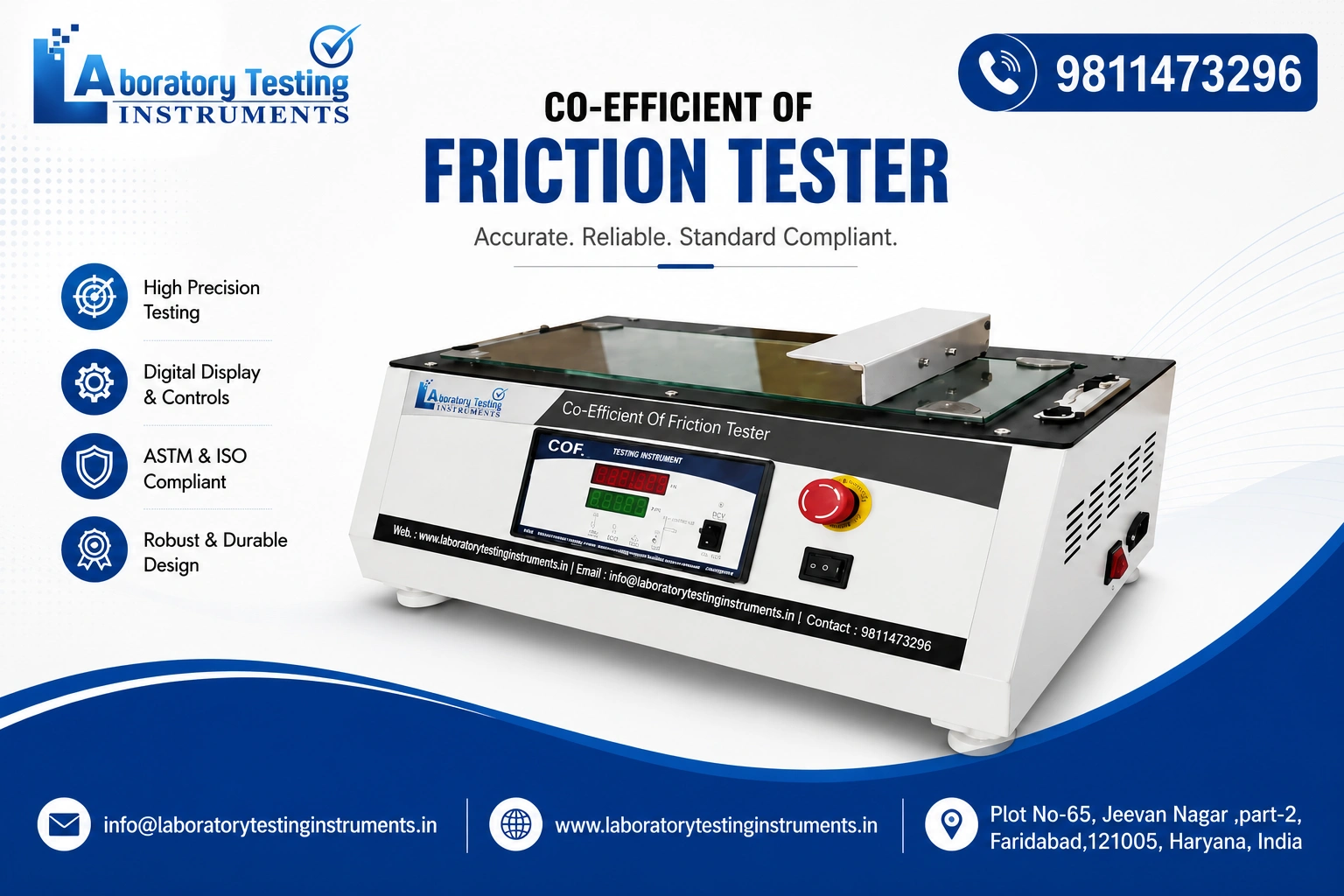
Maintaining the right surface friction plays a vital role in ensuring smooth manufacturing, efficient packaging, and reliable product performance. Moreover, manufacturers must evaluate friction accurately to maintain consistent product quality and production efficiency. Whether you produce plastic films, flexible packaging materials, laminated sheets, paper products, or labels, understanding their frictional characteristics helps you achieve better quality control. Therefore, using a Co-efficient of Friction Tester allows you to measure both static and kinetic friction accurately, making it an essential laboratory testing instrument for quality assurance and product testing.
A Co-efficient of Friction Tester accurately measures the resistance between two material surfaces during movement. Furthermore, it helps manufacturers evaluate whether plastic films, flexible packaging materials, paper, and laminated sheets provide the required slip properties for smooth production, packaging, transportation, and storage. To achieve accurate, reliable, and repeatable results, manufacturers perform coefficient of friction testing according to internationally recognized standards such as ASTM D1894 and ISO 8295. As a result, they can maintain consistent product quality, improve process efficiency, and meet global quality standards.
Among these standards, ASTM D1894 is the most widely recognized for evaluating the static and kinetic coefficient of friction of plastic films and sheeting. Other important standards, including ISO 8295, TAPPI T816, and BS 2782, are also used depending on the material type and testing requirements.
In this guide, we explain the international standards used for Co-efficient of Friction Tester applications and coefficient of friction testing. Additionally, you will learn why these standards play a crucial role in ensuring accurate, reliable, and repeatable test results. Furthermore, we discuss how following standards such as ASTM D1894 and ISO 8295 helps manufacturers maintain consistent product quality, improve production efficiency, and meet global quality requirements.
What Is a Co-efficient of Friction?
The Coefficient of Friction (COF) indicates how easily one surface moves over another. In simple terms, it measures the relationship between the force required to start or maintain movement and the force pressing two surfaces together. Furthermore, a Co-efficient of Friction Tester accurately measures this value, allowing manufacturers to evaluate material performance and ensure consistent quality. As a result, industries can improve coefficient of friction testing, optimize product performance, and meet international quality standards.
A material with a higher friction value offers greater resistance to sliding, while a lower friction value allows smoother movement.
Understanding the coefficient of friction is essential because it directly affects:
- Packaging machine efficiency
- Material handling
- Product stacking
- Transportation safety
- Printing performance
- Lamination quality
- Consumer usability
Manufacturers rely on accurate COF testing to optimize production processes and maintain consistent product quality.
Types of Co-efficient of Friction
A Co-efficient of Friction Tester measures two important friction values.
Static Co-efficient of Friction
Static COF measures the force required to start movement between two stationary surfaces.
This value helps manufacturers determine the amount of resistance before sliding begins. For example, materials with very high static friction can create feeding problems on packaging lines, while materials with very low friction may become unstable during storage and transportation. Therefore, manufacturers use a Co-efficient of Friction Tester to perform accurate coefficient of friction testing, optimize material performance, and ensure smooth packaging operations with consistent product quality.
Kinetic Co-efficient of Friction
Kinetic COF measures the force required to continue movement once sliding has already started.
This value plays an equally important role because it directly affects continuous material movement during converting, printing, packaging, sealing, and transportation. Moreover, manufacturers rely on a Co-efficient of Friction Tester to perform accurate coefficient of friction testing, ensuring smooth material handling, reducing production issues, and maintaining consistent product quality throughout the manufacturing process.
Both static and kinetic COF values provide valuable insights that help manufacturers improve product performance and maintain process stability. Furthermore, a Co-efficient of Friction Tester enables accurate coefficient of friction testing, allowing manufacturers to identify friction-related issues early, optimize production efficiency, and ensure consistent product quality across different applications.
Which Standard Is Used for Co-efficient of Friction Tester?
A Co-efficient of Friction Tester complies with internationally accepted testing standards to deliver accurate, reliable, and repeatable results. Moreover, these standards help manufacturers maintain testing consistency, improve coefficient of friction testing, and ensure dependable quality control across different materials. As a result, industries can enhance product performance, streamline production processes, and meet global quality requirements with confidence.
The most commonly followed standards include:
ASTM D1894
ASTM D1894 is the industry-standard testing method for determining the static and kinetic coefficient of friction of plastic films and sheeting.
This standard specifies:
- Test conditions
- Sled dimensions
- Test speed
- Sample preparation
- Force measurement procedure
- Calculation of static and kinetic COF values
Because of its reliability and worldwide acceptance, ASTM D1894 remains the preferred standard for coefficient of friction testing. Moreover, manufacturers of plastic films, flexible packaging materials, laminates, and industrial sheets rely on a Co-efficient of Friction Tester that complies with ASTM D1894 to achieve accurate, repeatable, and consistent test results.
The standard enables manufacturers to compare test results accurately across different laboratories and production facilities.
ISO 8295
ISO 8295 is another internationally recognized testing standard for determining the coefficient of friction of plastic films and sheets.
Many multinational manufacturers prefer ISO 8295 because it provides globally accepted testing procedures that support quality assurance and international trade.
Testing according to ISO standards ensures consistency across different manufacturing locations while helping companies meet export quality requirements.
TAPPI T816
TAPPI T816 is specifically developed for measuring the coefficient of friction of paper and paperboard materials.
Industries involved in:
- Paper manufacturing
- Carton production
- Printing
- Label manufacturing
- Corrugated packaging
often rely on TAPPI standards to evaluate the surface slip characteristics of their products.
This testing method helps maintain smooth feeding, stacking, printing, and packaging operations.
BS 2782
BS 2782 is a British Standard that includes testing methods for plastics and polymer-based materials.
Several sections within this standard are applicable to friction-related testing, making it useful for manufacturers producing plastic components, industrial sheets, and engineering materials.
Following BS standards improves product consistency while supporting compliance with international quality systems.
Why ASTM D1894 Is the Most Preferred Standard
Among all available testing standards, ASTM D1894 remains the preferred choice for evaluating friction properties because it provides a highly standardized testing procedure.
During testing, a prepared sample is placed on the testing platform while a standard sled is positioned over the material. The instrument moves the sled across the surface at a controlled speed while measuring the force required to start and maintain movement.
The recorded force values are automatically used to determine:
- Static Co-efficient of Friction
- Kinetic Co-efficient of Friction
Because every parameter is carefully controlled, ASTM D1894 delivers highly repeatable and reliable results, making it the preferred testing method for quality control laboratories worldwide.
How ASTM D1894 Benefits Manufacturers
Using ASTM D1894 allows manufacturers to:
- Ensure smooth packaging machine operation
- Improve production efficiency
- Reduce material sticking and slipping
- Minimize product rejection
- Improve packaging quality
- Maintain consistent material performance
- Meet customer specifications
- Comply with international quality standards
For industries producing flexible packaging materials, following ASTM D1894 significantly improves manufacturing consistency while reducing production downtime.
Importance of Co-efficient of Friction Testing
Accurate friction testing plays a vital role in quality control across various manufacturing industries. Even a slight variation in the coefficient of friction can affect production efficiency, packaging quality, and product safety.
For example, if a packaging film has a very high friction value, it may stick together during processing, causing machine stoppages and reducing production speed. On the other hand, if the friction value is too low, packages may slide during storage or transportation, leading to damaged products and customer complaints.
By using a Co-efficient of Friction Tester, manufacturers can identify these issues before products reach the market. Regular COF testing helps maintain consistent product quality, improve machine performance, and reduce material wastage.
Advantages of Standardized COF Testing
Following internationally recognized testing standards offers several benefits for manufacturers.
Some of the key advantages include:
- Accurate and repeatable test results
- Improved production consistency
- Better packaging performance
- Reduced machine downtime
- Lower material rejection rates
- Easier compliance with customer specifications
- Enhanced product reliability
- Improved export quality compliance
- Better quality assurance documentation
Standardized testing also allows manufacturers to compare results across different production batches and laboratories with confidence.
Applications of Co-efficient of Friction Tester
A Co-efficient of Friction Tester is widely used across multiple industries where surface slip characteristics directly influence manufacturing and product performance.
Plastic Film Industry
Plastic films used for flexible packaging require controlled friction levels to ensure smooth movement through packaging machines.
Flexible Packaging Industry
Manufacturers of pouches, wrappers, and laminated packaging materials use COF testing to maintain consistent sealing, feeding, and stacking performance.
Paper and Paperboard Industry
Paper manufacturers evaluate friction properties to improve printing, handling, packaging, and converting operations.
Laminate and Sheet Manufacturing
Decorative laminates, polymer sheets, and industrial films require friction testing to maintain consistent surface quality.
Label and Sticker Industry
Labels must provide the correct amount of slip resistance for smooth dispensing and application during automated production.
Printing Industry
Printing presses require materials with controlled friction values to ensure accurate sheet feeding and minimize production errors.
Textile Industry
Coated fabrics, technical textiles, and industrial materials undergo COF testing to evaluate surface performance.
Automotive Industry
Various polymer components, interior materials, and coated surfaces are tested to ensure durability and reliable friction characteristics.
Why Choose Laboratory Testing Instruments?
At Laboratory Testing Instruments, we manufacture high-quality testing equipment designed to meet the evolving requirements of modern quality control laboratories.
Our Co-efficient of Friction Tester is engineered for precision, repeatability, and compliance with internationally accepted testing standards such as ASTM D1894 and ISO 8295.
The instrument delivers highly accurate static and kinetic coefficient of friction measurements, helping manufacturers improve production efficiency while maintaining product consistency.
Whether you operate in the packaging, plastics, paper, printing, or converting industry, our testing solutions are designed to support your quality assurance process.
Features of Laboratory Testing Instruments Co-efficient of Friction Tester
Our Co-efficient of Friction Tester is designed with advanced technology to deliver dependable and repeatable results.
Key features include:
- High-precision load cell for accurate force measurement
- Measurement of both static and kinetic coefficient of friction
- Compliance with ASTM D1894 and ISO 8295
- User-friendly testing interface
- Stable and repeatable performance
- Durable construction for long service life
- Suitable for laboratory and production quality control
- Low maintenance requirements
- High testing accuracy
- Reliable quality assurance support
These features make the instrument suitable for research laboratories, manufacturing facilities, quality control departments, and testing centers.
Why Regular COF Testing Matters
Routine friction testing helps manufacturers maintain product consistency and reduce production-related issues.
Benefits of regular testing include:
- Improved packaging efficiency
- Better machine productivity
- Reduced customer complaints
- Consistent material performance
- Better inventory handling
- Reduced production losses
- Improved product acceptance
- Stronger quality control systems
Regular testing also supports continuous process improvement by identifying material variations before they impact production.
Frequently Asked Questions (FAQs)
1. What is a Co-efficient of Friction Tester?
A Co-efficient of Friction Tester is a laboratory testing instrument used to measure the static and kinetic coefficient of friction between two material surfaces.
2. Which standard is commonly used for COF testing?
The most widely accepted standard is ASTM D1894 for plastic films and sheeting. Other commonly used standards include ISO 8295, TAPPI T816, and BS 2782 depending on the material being tested.
3. What materials can be tested using a COF Tester?
A Co-efficient of Friction Tester can evaluate:
- Plastic films
- Packaging materials
- Laminates
- Paper
- Paperboard
- Labels
- Flexible sheets
- Coated materials
- Polymer films
4. What is the difference between static and kinetic coefficient of friction?
Static coefficient of friction measures the force required to initiate movement, whereas kinetic coefficient of friction measures the force required to maintain movement after sliding has started.
5. Why is ASTM D1894 important?
ASTM D1894 provides a standardized testing procedure that ensures reliable, repeatable, and internationally accepted friction test results.
6. Which industries use a Co-efficient of Friction Tester?
The instrument is widely used in:
- Packaging
- Plastics
- Paper
- Printing
- Textile
- Automotive
- Laminate manufacturing
- Quality control laboratories
Conclusion
A Co-efficient of Friction Tester is an essential quality control instrument for evaluating the frictional properties of packaging materials, plastic films, paper, laminates, and other flexible substrates. Using internationally recognized testing standards such as ASTM D1894, ISO 8295, TAPPI T816, and BS 2782 ensures that test results are accurate, repeatable, and accepted across global industries.
By investing in reliable friction testing equipment, manufacturers can improve packaging performance, reduce production issues, enhance product quality, and comply with international quality standards.
Contact Laboratory Testing Instruments
If you are looking for a reliable Co-efficient of Friction Tester that delivers accurate and repeatable results in accordance with international testing standards, Laboratory Testing Instruments offers advanced solutions tailored to your quality control needs.
Laboratory Testing Instruments
Address:
Plot No. 65, Jeevan Nagar, Part-2, Faridabad – 121005, Haryana, India
Phone:
+91 9811473296
+91 9555515525
Email:
info@laboratorytestinginstruments.in
Website:
https://laboratorytestinginstruments.in/
Contact our technical experts today to learn more about our Co-efficient of Friction Tester and discover the right testing solution for your laboratory or manufacturing facility.